Vulnerability Report - August 2026
Introduction
This vulnerability report has been generated with the help of AI, using the VulnMCP tooling on top of Vulnerability-Lookup, with contributions from the platform’s community.
It highlights the most frequently sighted vulnerabilities for August 2026, based on data aggregated from Vulnerability-Lookup, the CISA Known Exploited Vulnerabilities catalog, the CIRCL KEV catalog, the ENISA EUVD / EU CSIRTs Network feed, honeypot observations from The Shadowserver Foundation, the Previdian catalog (formerly known as KEVIntel – same catalog, new name), and contributor comments and bundles. These five KEV catalogs are federated through the GCVE initiative: each one is identified by the UUID of the Global Naming Authority (GNA) that publishes it, and exchanged between instances following the GCVE-BCP-07 specification – which is what makes the catalog coverage comparison further down possible. Sightings come from MISP, Exploit-DB, Bluesky, Mastodon, Telegram, GitHub Gists, Nuclei, SPLOITUS, Metasploit, and more. For further details, please visit this page.
August was the month the AI and developer-tooling stack stopped being a footnote. CISA listed Langflow, Ray and MLflow as exploited within three weeks of each other, Shadowserver’s honeypots recorded thousands of daily connections against MLflow and SGLang, and Previdian added a further dozen AI-adjacent entries – Flowise, Milvus, Langflow again, an autonomous “AI agent company” server called Paperclip. The second thread running through the month is authentication that simply does not hold: N-able N-central (twice, once for an incomplete patch), TrueConf, PaperCut, ownCloud, macOS Screen Sharing and SharePoint all entered the CISA catalog for letting unauthenticated callers through. Meanwhile the CVE Program set yet another monthly record, and the KEV catalogs collectively flagged 103 vulnerabilities – up from 65 in July.
The Month at a Glance
12,313 CVEs were published in August 2026 (from the CVE List v5 source alone), up from 9,808 in July – a 25.5% month-over-month increase and, once again, the highest monthly volume ever recorded. Vulnerability-Lookup also ingested 11,571 GitHub security advisories and 250 PySec advisories over the same period.
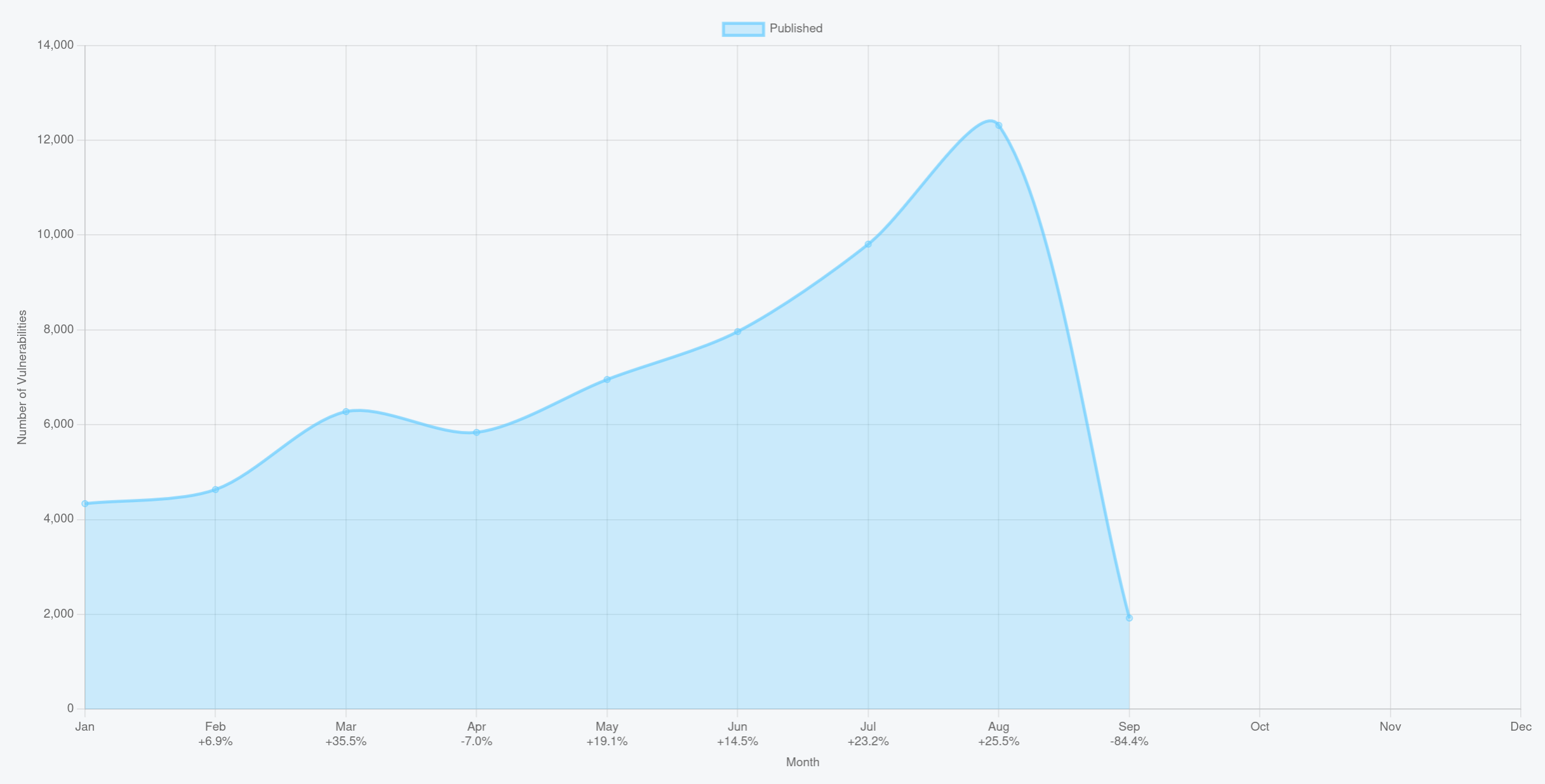
Evolution of published CVEs in 2026 (CVE Program source), as shown on the Vulnerability-Lookup dashboard. The September data point only covers the first days of the month.
Vulnerability-Lookup collected 43,008 sightings across 13,594 distinct vulnerabilities during August 2026, down from July’s 61,263. The breakdown:
| Sighting type | Count | Distinct vulnerabilities |
|---|---|---|
| Seen | 31,697 | 12,495 |
| Published proof of concept | 7,474 | 2,985 |
| Exploited | 3,595 | 883 |
| Confirmed | 242 | 70 |
The drop in total volume is entirely a “seen” effect: mentions and discussions fell from 51,332 in July to 31,697 (-38%), while the categories that carry more signal moved the other way. Published proof-of-concept sightings grew again, from 6,092 to 7,474 (+23%), and confirmed sightings nearly doubled, from 134 to 242 across 70 distinct vulnerabilities. Exploitation-typed sightings held steady at 3,595 (-3%), so the month’s real exploitation picture is flat, not falling. No “patched” sightings were recorded.
The daily breakdown shows that the proof-of-concept wave which began on 11 July did not stop at the month boundary: the first four days of August alone account for 3,174 proof-of-concept sightings, 42% of the month’s total, before the stream settles to a few hundred per day. The “seen” band peaks on 12 August (2,051), the day after Microsoft’s Patch Tuesday, and the busiest day overall is 3 August with 2,763 sightings. The quietest stretch is the weekend of 8–9 August, under 520 per day.
In the exploitation-typed sightings, Log4Shell (CVE-2021-44228, 75 exploitation reports) remains the single most reported vulnerability for yet another month, ahead of the React Server Components pre-authentication RCE CVE-2025-55182 (41), the Cisco IOS XE web UI privilege escalation CVE-2023-20198 (35) and the cPanel/WHM login-flow authentication bypass CVE-2026-41940 (34) – the only 2026 entry in that top four. Proof-of-concept activity, by contrast, concentrated on two very new issues: the Linux kernel rtmutex flaw CVE-2026-43499 (91 proof-of-concept sightings) and the pre-authentication reflected XSS on the WordPress login screen CVE-2026-64638 (70), disclosed on 7 August and escalatable to code execution with user interaction.
Top 10 Vendors of the Month
Linux takes back the top of the vendor ranking from Oracle, with well over a third of the month’s attributed CVEs – the kernel CVE flood again – ahead of Oracle, Microsoft, Google and IBM.
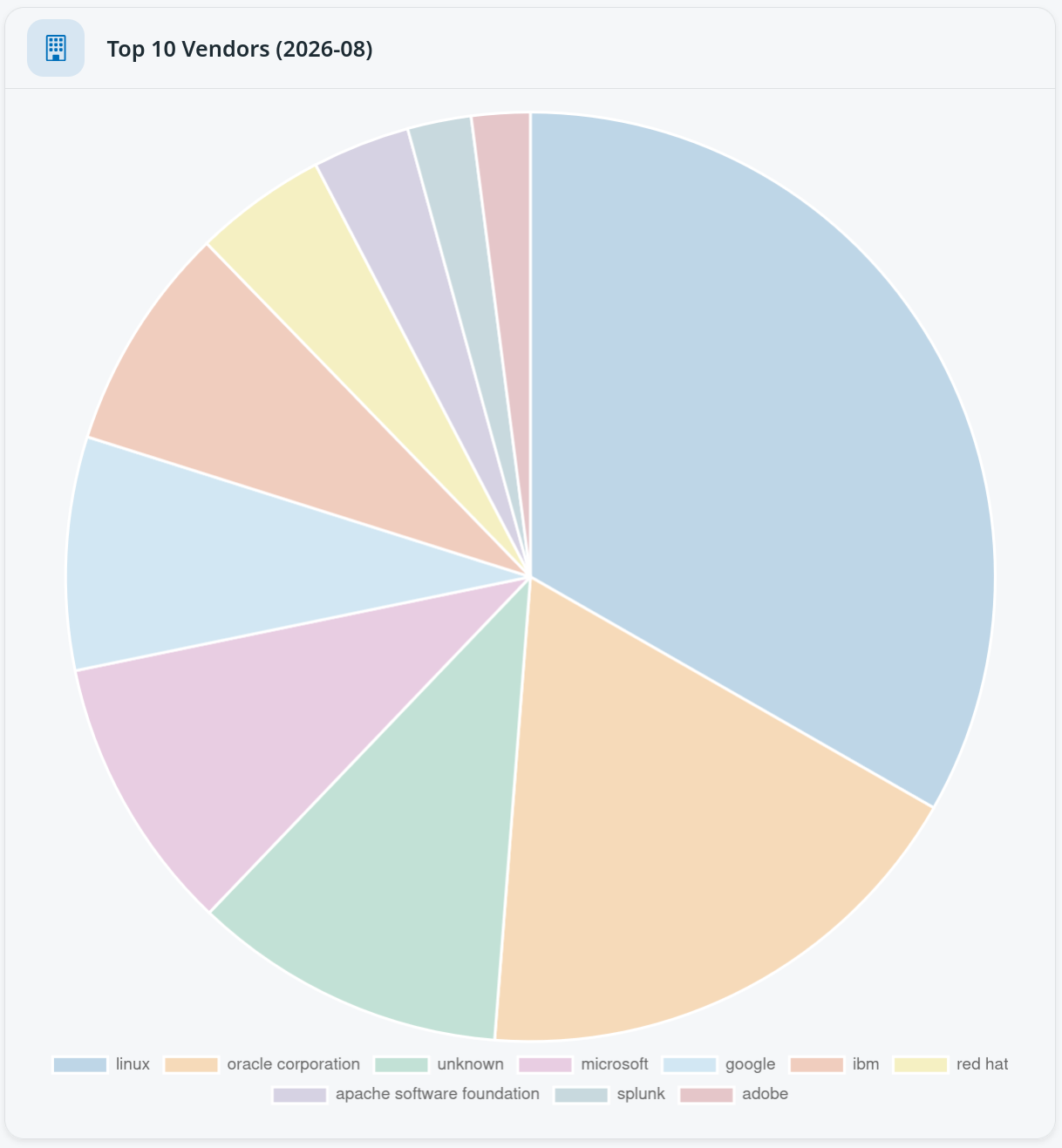
Top 10 Assigners of the Month
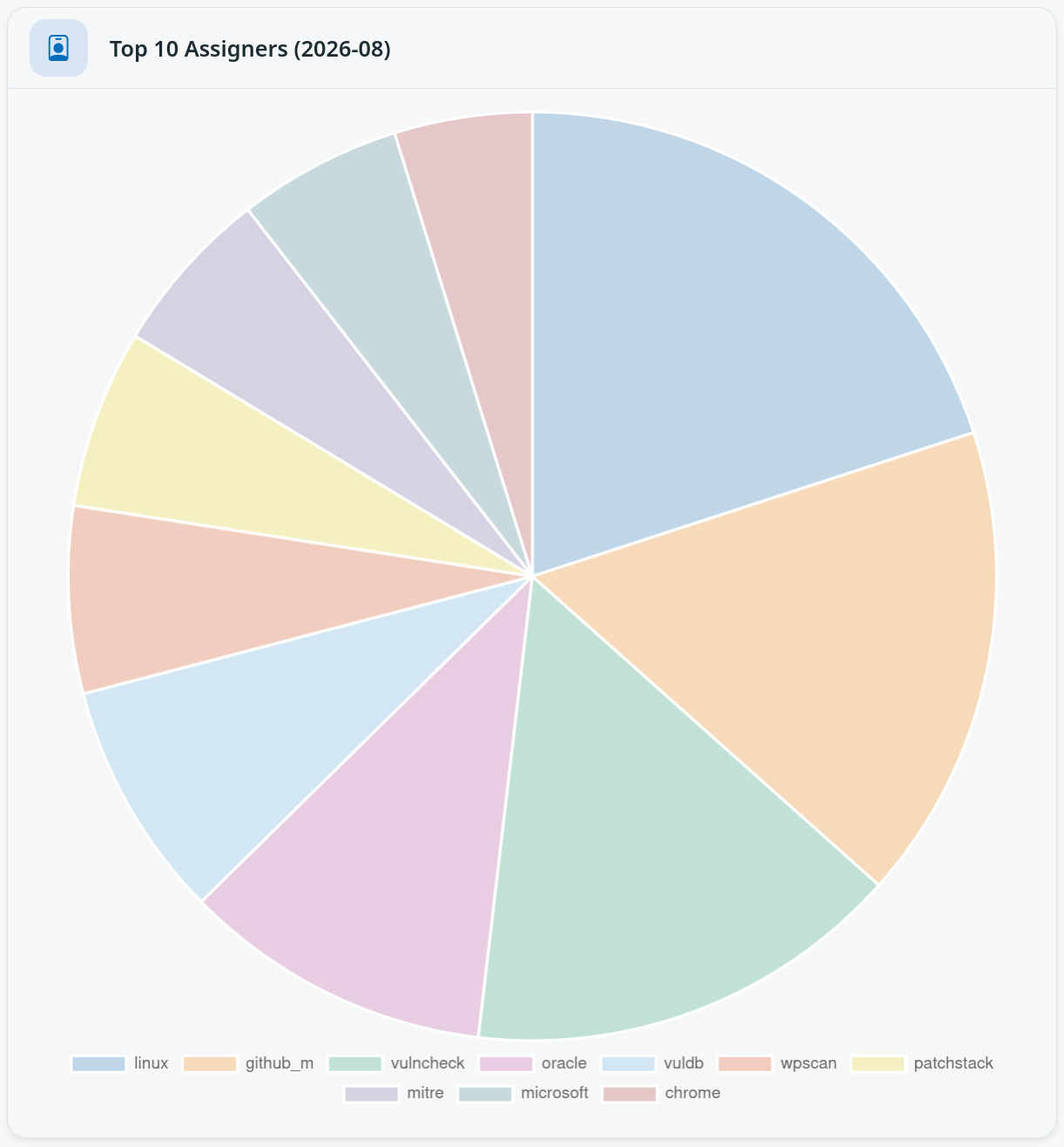
Top 10 Credits of the Month
WPScan leads the credits ranking by a wide margin, credited on more than 500 published vulnerabilities, ahead of the VulDB CNA Team; the rest of the list is dominated by the WordPress ecosystem (Wordfence PRISM, Patchstack) and by Red Hat.
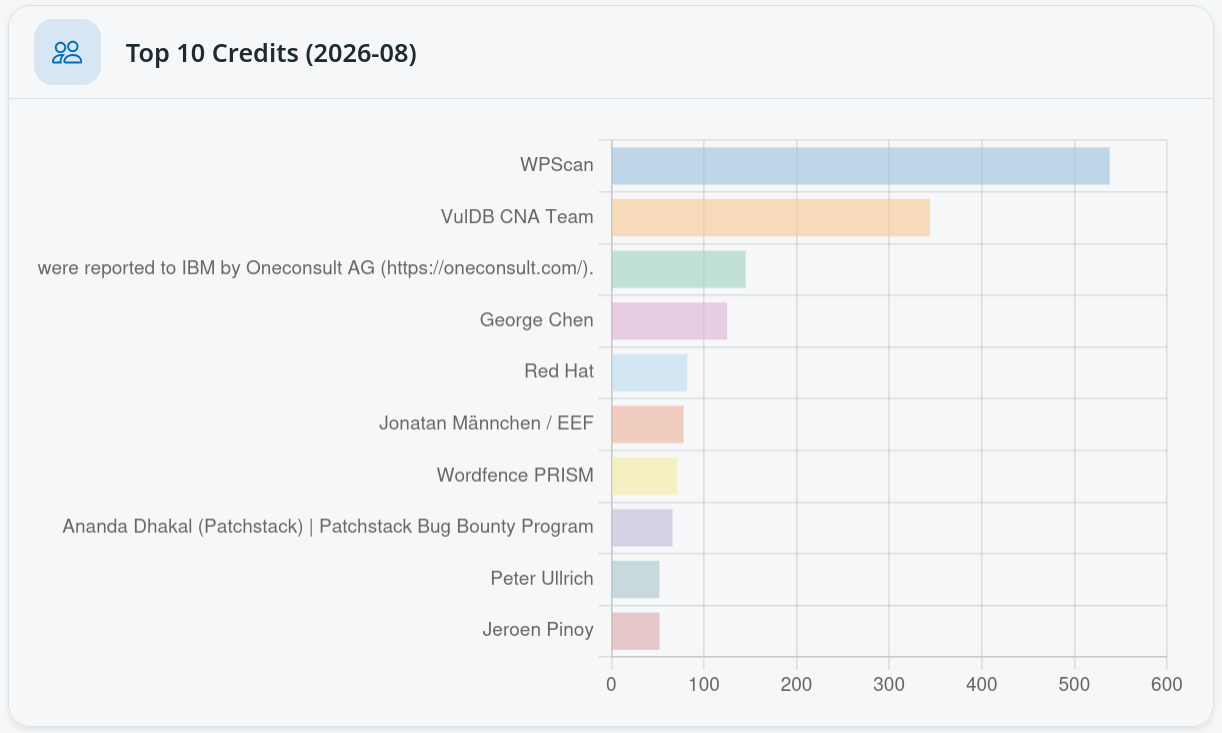
The complete list of credits is available on Vulnerability-Lookup.
Top 10 Vulnerabilities of the Month
| Vulnerability | Sighting Count | Vendor | Product | VLAI Severity |
|---|---|---|---|---|
| CVE-2026-68820 | 162 | Microsoft | Windows (Ancillary Function Driver for WinSock) | High (confidence: 0.9969) |
| CVE-2026-19478 | 156 | GitLab | GitLab CE/EE | Critical (confidence: 0.8705) |
| CVE-2025-55182 | 155 | Meta | React Server Components | Critical (confidence: 0.9933) |
| CVE-2026-64638 | 151 | WordPress | Core (login screen) | High (confidence: 0.8675) |
| CVE-2026-43499 | 144 | Linux | Kernel (rtmutex) | High (confidence: 0.9891) |
| CVE-2026-55040 | 143 | Microsoft | SharePoint Server | High (confidence: 0.5339) |
| CVE-2026-18577 | 143 | N-able | N-central | Critical (confidence: 0.8912) |
| CVE-2021-44228 | 139 | Apache | Log4j2 | High (confidence: 0.5546) |
| CVE-2026-63077 | 138 | JetBrains | TeamCity | Critical (confidence: 0.8997) |
| CVE-2026-73570 | 134 | Zimbra | Collaboration (ZCS) | High (confidence: 0.8793) |
The list is unusually balanced this month: the top ten are separated by fewer than 30 sightings, and no single vulnerability dominates the way the WordPress core pair did in July. The Windows Ancillary Function Driver use-after-free CVE-2026-68820, patched on 11 August and added to the CISA catalog the same day, takes first place; it was used as a zero-day by a state-sponsored actor delivering exploits through fake job offers, and was reported to the ENISA feed on that basis. It is followed by the GitLab GraphQL code injection CVE-2026-19478, which CIRCL confirmed as exploited on 21 August, and by three vulnerabilities that were already in the top ten in July: React Server Components, the Linux kernel rtmutex issue and the SharePoint CVE-2026-55040 – the JWT authentication bypass a contributor bundled last month, which CISA listed on 18 August. N-able N-central enters on the strength of CVE-2026-18577, the incomplete fix for an administrative account takeover; JetBrains TeamCity (CVE-2026-63077, unauthenticated RCE via the agent polling protocol) and Zimbra (CVE-2026-73570, command injection through SNMP notifications) close the list, both also new CISA entries.
Known Exploited Vulnerabilities
New entries were added to the tracked Known Exploited Vulnerabilities catalogs during August. The five catalogs are complementary rather than redundant: CISA is the reference set, CIRCL and the ENISA / EU CSIRTs Network feed add European confirmations, Shadowserver’s honeypots show what is actually being attacked on the wire, and Previdian aggregates public exploitation reports at higher volume and often earlier – each of the last two surfacing vulnerabilities no other catalog lists.
A total of 103 distinct vulnerabilities entered at least one tracked catalog this month, against 65 in July: 32 were added by CISA, 2 by CIRCL, 7 were reported through the ENISA / EU CSIRTs Network feed, 35 were observed for the first time by Shadowserver’s honeypots and 88 were added by Previdian. Every catalog except CIRCL, stable at two entries, grew substantially.
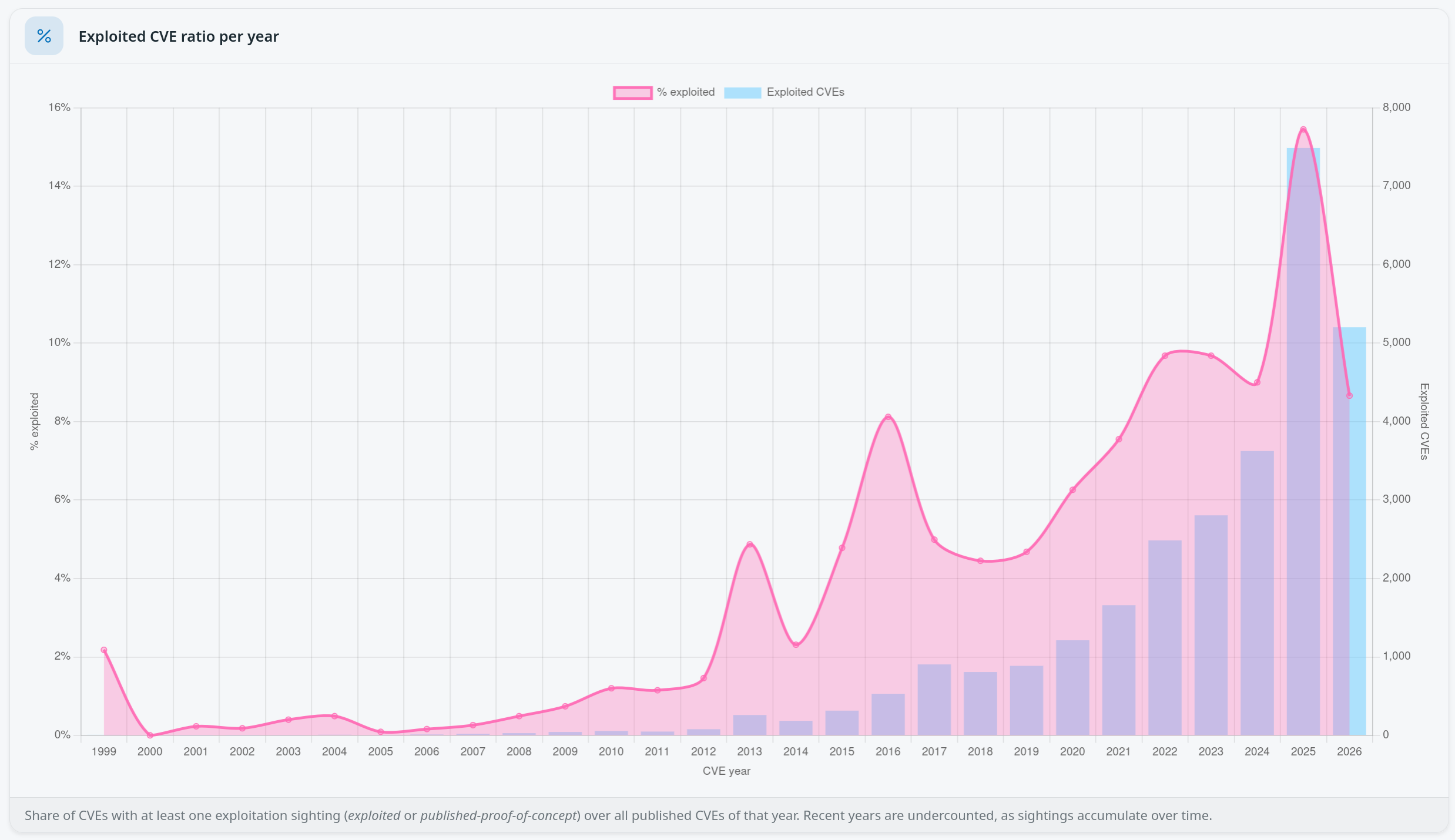
The evolution of the exploited CVE ratio per year: share of CVEs with at least one exploitation or proof-of-concept sighting over all published CVEs of that year. Recent years are undercounted, as sightings accumulate over time.
The AI stack is the story of the month. CISA listed three AI-platform vulnerabilities in
three weeks: the Langflow auto-login-to-exec() chain
CVE-2026-9198 on 4 August (Langflow’s third
CISA listing since July, and its sixth overall), the Ray DNS-rebinding RCE
CVE-2025-62593 on 18 August, and the
MLflow unauthenticated full-read SSRF
CVE-2026-64849 on 19 August. Shadowserver
saw the wave from the honeypot side: an MLflow authentication bypass
(CVE-2026-2652) has been drawing traffic
since 7 August and was still at 2,455 connections a day in early September, the SGLang model
server deserialization CVE-2025-10164 at
243 a day, alongside Flowise, Windmill and Dozzle. Previdian adds Milvus, three more Langflow
issues, a second Flowise flaw and two further MLflow entries, and the ENISA feed contributes
Paperclip (CVE-2026-41679), an AI-agent
orchestration server with a six-request unauthenticated RCE chain. Counting every catalog,
roughly one August KEV entry in seven concerns AI or ML tooling.
The second pattern is authentication bypass in management-plane software. N-able N-central opened the month with CVE-2026-18577 on 3 August – an incomplete patch – followed one day later by CVE-2026-18556, the original bypass that patch was meant to fix. TrueConf Server contributed a pair on 20 August (missing authentication on port 4307 plus sandbox escape), PaperCut NG/MF a pair on 31 August (authentication bypass plus unsafe class loading), and Apple macOS (CVE-2026-65400) let network attackers authenticate to Screen Sharing without credentials. Microsoft had five CISA entries: the AFD zero-day, the SharePoint weak-authentication bypass, the Windows IKE double free CVE-2026-33824, the Entra ID deserialization RCE CVE-2026-69836 – CVSS 10.0, and visible in no other catalog – and a 2019 SQL Server RCE. CERT-PL separately reported an Exchange Server spoofing issue (CVE-2026-42897) to the ENISA feed.
On the infrastructure side, Broadcom VMware vCenter is the entry with the widest corroboration: the Syslog-server path traversal CVE-2026-59310 was reported to the ENISA feed on 10 August (the cited source counts 361 victim IPs across 47 countries), flagged by Previdian on 12 August, listed by CISA on 18 August, and a contributor documented in-the-wild exploitation of the companion authentication bypass CVE-2026-59309 below. Citrix NetScaler returns with the memory overflow CVE-2026-8452 (the “CitrixBleed To Infinity” issue bundled in July; CISA on 26 August, nine days after Previdian), Cisco ASA/FTD with a remote-access VPN denial of service (CVE-2026-20349), Progress LoadMaster with the command injection CVE-2026-8037 that Shadowserver and Previdian had both reported in early July – 37 days before CISA – and Oracle with the CVSS 10.0 WebLogic proxy plug-in issue CVE-2026-21962. Two more Oracle-adjacent entries stand out: NCSC-HU reported the 2017 WebLogic XMLDecoder flaw CVE-2017-10271 as ransomware-exploited, and that entry is the only vulnerability of the month present in four catalogs at once.
Developer platforms filled the remaining slots: Gitea (CVE-2026-60004, RCE through the diffpatch API), JFrog Artifactory (CVE-2026-66384), JetBrains TeamCity, Metabase (CVE-2026-72898, SQL injection via the password-reset endpoint, CVSS 10.0), plus GitLab in the CIRCL catalog and Gogs, SPIP, Qwik and vBulletin in Previdian.
CISA also re-anchored a cluster of old local privilege escalations on 26 August – the Red Hat libuser race CVE-2015-3246, the ABRT symlink issue CVE-2015-5287 and the kernel watch_queue out-of-bounds write CVE-2022-0995 – together with the Ajax.NET Professional deserialization CVE-2021-23758 and, the next day, the ownCloud pre-signed URL bypass CVE-2023-49105 and a fresh Linux kernel IPv6 privilege escalation (CVE-2026-53362). Three Linux kernel or Red Hat userland entries in two days is unusual for the CISA catalog and points at a post-compromise toolkit rather than an initial-access campaign.
Across the month’s KEV additions, the dominant weakness patterns were code injection and deserialization (CWE-94/502: Langflow, Ray, TrueConf, Gitea, TeamCity, Entra ID, Ajax.NET, PTC Windchill), missing or improper authentication (CWE-287/288/305/306/1390: N-central, TrueConf, PaperCut, ownCloud, macOS, SharePoint, WebLogic), path traversal (CWE-22: vCenter, Artifactory) and, for the honeypot-observed set, SQL injection and file upload in Chinese enterprise software (Weaver E-cology, Yonyou KSOA, Hongjing e-HR).
Catalog coverage
103 distinct vulnerabilities entered at least one of the tracked KEV catalogs during August. The matrix below shows, for each of them, which catalogs cover it (as of publication) – built with the KEV catalog coverage feature of Vulnerability-Lookup. Previdian is by far the widest net with 97 of the 103, ahead of Shadowserver (38) and CISA (37, including entries it had listed before August). Only one vulnerability of the month is present in four catalogs at once: the 2017 Oracle WebLogic deserialization flaw CVE-2017-10271, reported by NCSC-HU to the ENISA feed on 10 August and long since listed by CISA, Shadowserver and Previdian. Nine more are in three catalogs, among them the vCenter path traversal, the Zimbra command injection, the Windows AFD zero-day, the PTC Windchill RCE and the Metabase SQL injection.
At the other end, 35 entries are visible through a single catalog: 30 only via Previdian (the Flowise, Milvus and Langflow cluster, SPIP, Gogs, Qwik, vBulletin, the two SonicWall GMS issues, the Kaseya VSA pair, SAP Commerce Cloud and several older high-EPSS issues), 2 only via CISA (the Entra ID deserialization RCE CVE-2026-69836 and the macOS Screen Sharing bypass CVE-2026-65400), 1 only via Shadowserver (a GeoServer issue, CVE-2026-76904), 1 only via ENISA (Paperclip, CVE-2026-41679) and 1 only via CIRCL – GCVE-1-2026-20208, a heap overflow in Ruijie Reyee switches discovered on a CIRCL honeypot and, having no CVE, only identifiable through its GCVE number.
CISA
The CISA KEV catalog added 32 entries in August, beating July’s 26 and making it the busiest month of the year so far. None of them carries a known ransomware campaign use flag.
| CVE ID | Date Added | Vendor | Product | VLAI Severity |
|---|---|---|---|---|
| CVE-2026-82078 | 2026-08-31 | PaperCut | NG/MF | Critical (confidence: 0.5929) |
| CVE-2026-81578 | 2026-08-31 | PaperCut | NG/MF | Critical (confidence: 0.6096) |
| CVE-2026-66384 | 2026-08-27 | JFrog | Artifactory | Medium (confidence: 0.9677) |
| CVE-2026-53362 | 2026-08-27 | Linux | Kernel (IPv6) | High (confidence: 0.9344) |
| CVE-2023-49105 | 2026-08-27 | ownCloud | ownCloud | Critical (confidence: 0.9601) |
| CVE-2026-8452 | 2026-08-26 | Citrix | NetScaler ADC and Gateway | High (confidence: 0.9901) |
| CVE-2022-0995 | 2026-08-26 | Linux | Kernel (watch_queue) | High (confidence: 0.9906) |
| CVE-2021-23758 | 2026-08-26 | Ajax.NET Professional | AjaxPro.2 | Critical (confidence: 0.7742) |
| CVE-2019-1068 | 2026-08-26 | Microsoft | SQL Server | High (confidence: 0.7964) |
| CVE-2015-5287 | 2026-08-26 | Red Hat | Automatic Bug Reporting Tool (ABRT) | High (confidence: 0.7754) |
| CVE-2015-3246 | 2026-08-26 | Red Hat | libuser | Medium (confidence: 0.8707) |
| CVE-2026-60004 | 2026-08-25 | Gitea | Gitea | Critical (confidence: 0.8568) |
| CVE-2026-21962 | 2026-08-24 | Oracle | HTTP Server / WebLogic Server Proxy Plug-in | Critical (confidence: 0.9978) |
| CVE-2026-73570 | 2026-08-21 | Synacor | Zimbra Collaboration Suite (ZCS) | High (confidence: 0.8793) |
| CVE-2026-69836 | 2026-08-21 | Microsoft | Entra ID | Critical (confidence: 0.9884) |
| CVE-2026-72530 | 2026-08-20 | TrueConf | Server | Critical (confidence: 0.9816) |
| CVE-2026-72529 | 2026-08-20 | TrueConf | Server | Critical (confidence: 0.9908) |
| CVE-2026-64849 | 2026-08-19 | MLflow | MLflow | High (confidence: 0.9442) |
| CVE-2026-65400 | 2026-08-18 | Apple | macOS (Screen Sharing) | Critical (confidence: 0.7433) |
| CVE-2026-59310 | 2026-08-18 | Broadcom | VMware vCenter | Critical (confidence: 0.9792) |
| CVE-2026-55040 | 2026-08-18 | Microsoft | SharePoint | High (confidence: 0.5339) |
| CVE-2026-33824 | 2026-08-18 | Microsoft | Windows IKE Service Extensions | Critical (confidence: 0.7548) |
| CVE-2025-62593 | 2026-08-18 | Ray-Project | Ray | Critical (confidence: 0.9166) |
| CVE-2026-72898 | 2026-08-11 | Metabase | Metabase | Critical (confidence: 0.8841) |
| CVE-2026-68820 | 2026-08-11 | Microsoft | Windows Ancillary Function Driver for WinSock | High (confidence: 0.9969) |
| CVE-2026-20349 | 2026-08-11 | Cisco | Secure Firewall ASA and FTD | High (confidence: 0.9645) |
| CVE-2026-8037 | 2026-08-07 | Progress | LoadMaster | Critical (confidence: 0.9903) |
| CVE-2026-63077 | 2026-08-05 | JetBrains | TeamCity | Critical (confidence: 0.8997) |
| CVE-2026-9198 | 2026-08-04 | IBM | Langflow | Critical (confidence: 0.9892) |
| CVE-2026-34486 | 2026-08-04 | Apache | Tomcat | High (confidence: 0.841) |
| CVE-2026-18556 | 2026-08-04 | N-able | N-central | Critical (confidence: 0.6069) |
| CVE-2026-18577 | 2026-08-03 | N-able | N-central | Critical (confidence: 0.8912) |
More KEV entries from the CISA Catalog.
CIRCL
The CIRCL KEV catalog added 2 entries during August, both marked as confirmed exploitation. One of them has no CVE at all: GCVE-1-2026-20208 is a heap-based buffer overflow in Ruijie Reyee RG-ES208GC switches, discovered on a honeypot operated by CIRCL and published under CIRCL’s own GCVE numbering – a concrete example of a KEV entry that only exists because the catalog is not tied to the CVE namespace.
| CVE ID | Date Added | Vendor | Product | VLAI Severity |
|---|---|---|---|---|
| GCVE-1-2026-20208 | 2026-08-24 | Ruijie | Reyee RG-ES208GC switch | High (confidence: 0.9684) |
| CVE-2026-19478 | 2026-08-21 | GitLab | GitLab CE/EE | Critical (confidence: 0.8705) |
More KEV entries from the CIRCL Catalog.
ENISA (EUVD)
Seven entries were reported through the ENISA / EU CSIRTs Network (CNW) KEV feed during August, a busy month for the feed: three by ENISA itself, two by CERT-PL (Exchange Server and Zimbra, the latter noting “exploitation waves since the beginning of August”), one by NCSC-HU (the 2017 WebLogic flaw, tagged as ransomware-related) and one through the CNW channel (Paperclip). Two entries are attributed to APT activity – the Windows AFD zero-day and the vCenter path traversal – and the PTC Windchill deserialization RCE CVE-2026-12569 is tagged as used in ransomware operations.
| CVE ID | Date Reported | Vendor | Product | Reported by | VLAI Severity |
|---|---|---|---|---|---|
| CVE-2026-73570 | 2026-08-18 | Zimbra | Collaboration (ZCS) | CERT-PL | High (confidence: 0.8793) |
| CVE-2026-42897 | 2026-08-18 | Microsoft | Exchange Server | CERT-PL | High (confidence: 0.553) |
| CVE-2026-41679 | 2026-08-17 | paperclipai | Paperclip | CNW | Critical (confidence: 0.9798) |
| CVE-2026-12569 | 2026-08-16 | PTC | Windchill PDMLink / FlexPLM | ENISA | Critical (confidence: 0.9957) |
| CVE-2026-68820 | 2026-08-11 | Microsoft | Windows | ENISA | High (confidence: 0.9969) |
| CVE-2026-59310 | 2026-08-10 | VMware | vCenter | ENISA | Critical (confidence: 0.9792) |
| CVE-2017-10271 | 2026-08-10 | Oracle | WebLogic Server | NCSC-HU | High (confidence: 0.8614) |
More KEV entries from the ENISA Catalog.
The Shadowserver Foundation
The Shadowserver KEV catalog is fed by honeypot-observed exploitation attempts. 35 vulnerabilities were observed for the first time during August, four of which are in the CISA KEV catalog. The most striking one is the July SharePoint entry CVE-2026-50522, which only started hitting honeypots on 16 August, three and a half weeks after its CISA listing, and was still at 2,103 connections a day in early September – second only to the MLflow authentication bypass (2,455). The rest of the list is a mix of AI-system endpoints (MLflow, SGLang, Flowise, Windmill, Dozzle), consumer routers (D-Link DIR-868L, Tenda, TP-Link, Totolink, ASUS AiCloud, Zeroshell) and a cluster of Chinese enterprise applications (Weaver E-cology, Yonyou KSOA, Hongjing e-HR, Ruijie NBR) that no Western catalog tracks. Severity values are reproduced as published by Shadowserver (CVSS).
More KEV entries from the Shadowserver Catalog.
Previdian (formerly KEVIntel)
The Previdian catalog – the catalog reported as KEVIntel in previous editions, renamed but otherwise unchanged – aggregates public exploitation reports and added 88 entries in August, nearly double July’s 48 and by far the highest volume of the tracked feeds. It covers 29 of CISA’s 32 additions for the month; the three it lacks are the Zimbra command injection CVE-2026-73570, the Entra ID RCE CVE-2026-69836 and the macOS Screen Sharing bypass CVE-2026-65400.
Nine of those it flagged before CISA did: the Progress LoadMaster command injection CVE-2026-8037 on 1 July, a full 37 days ahead; the NetScaler memory overflow CVE-2026-8452 by 9 days; the vCenter path traversal CVE-2026-59310 and the SharePoint authentication bypass CVE-2026-55040 by 6 days each; both PaperCut issues (CVE-2026-81578, CVE-2026-82078) by 4 days; the first N-central bypass CVE-2026-18556 by 3 days; and the Metabase SQL injection and the MLflow SSRF by one day each. Nineteen were listed on the same day as CISA, and only the Oracle WebLogic proxy plug-in issue came a day later.
30 entries are unique to Previdian this month. The AI cluster is again the most visible – Milvus (CVE-2026-26190, unauthenticated access to the metrics-port REST API), three Langflow issues (CVE-2026-0768, CVE-2026-33497, CVE-2026-55450), a Flowise OAuth secrets disclosure (CVE-2026-56270) and a second MLflow file read (CVE-2026-2614) – next to a web-application set that includes two SPIP unauthenticated RCEs, Gogs (CVE-2026-52806), the Qwik framework deserialization CVE-2026-27971, vBulletin (CVE-2026-61511, 70.8% EPSS), a SAP Commerce Cloud improper authorization rated CVSS 10.0 (CVE-2026-58231) and two WordPress premium plugins shipped with tampered builds (Ninja Tables Pro and Fluent Forms Pro), as well as the Cisco ISE unauthenticated RCE CVE-2025-20282 and the two SonicWall GMS authentication issues from 2023. Across the full list, legacy issues with very high EPSS also resurface: Zeroshell CVE-2019-12725 (89.8%, also seen by Shadowserver’s honeypots) and Ajax.NET CVE-2021-23758 (89.1%, listed by CISA the same day).
Vendor, product, CVSS and EPSS values below are reproduced as published by Previdian.
| CVE ID | Date Added | Vendor | Product | Severity (Previdian) | EPSS |
|---|---|---|---|---|---|
| CVE-2026-2614 | 2026-08-29 | mlflow | mlflow/mlflow | High (CVSS 7.5) | 2.98% |
| CVE-2026-0768 | 2026-08-29 | Langflow | Langflow | Critical (CVSS 9.8) | 2.34% |
| CVE-2023-7330 | 2026-08-29 | Beijing Star-Net Ruijie Network Technology Co., Ltd. | NBR Series Routers | Critical (CVSS 9.3) | 0.62% |
| CVE-2024-58374 | 2026-08-28 | Hongjing Century | e-HR | High (CVSS 8.7) | 0.47% |
| CVE-2026-82078 | 2026-08-27 | PaperCut | PaperCut MF/NG | Critical (CVSS 9.4) | – |
| CVE-2026-81578 | 2026-08-27 | PaperCut | PaperCut MF/NG | High (CVSS 8.8) | – |
| CVE-2026-66384 | 2026-08-27 | jfrog | artifactory | Medium (CVSS 5.3) | 0.26% |
| CVE-2026-61511 | 2026-08-27 | vBulletin | vBulletin | Critical (CVSS 9.3) | 70.77% |
| CVE-2026-53362 | 2026-08-27 | Linux | Linux | High (CVSS 7.8) | 0.27% |
| CVE-2023-49105 | 2026-08-27 | ownCloud | ownCloud | Critical (CVSS 9.8) | 11.07% |
| CVE-2023-34132 | 2026-08-26 | SonicWall | GMS, Analytics | Critical (CVSS 9.8) | 7.68% |
| CVE-2023-34124 | 2026-08-26 | SonicWall | GMS, Analytics | Critical (CVSS 9.8) | 49.08% |
| CVE-2022-0995 | 2026-08-26 | Linux | kernel | High (CVSS 7.8) | 6.34% |
| CVE-2021-23758 | 2026-08-26 | michaelschwarz | AjaxPro.2 | High (CVSS 8.1) | 89.10% |
| CVE-2019-1068 | 2026-08-26 | Microsoft | Microsoft SQL Server 2014 Service Pack 2 for 32-bit Systems (GDR), … | High (CVSS 8.8) | 44.66% |
| CVE-2015-5287 | 2026-08-26 | Red Hat | Automatic Bug Reporting Tool (ABRT) | High (CVSS 7.8) | 3.41% |
| CVE-2015-3246 | 2026-08-26 | null | libuser | Medium (CVSS 5.1) | 7.09% |
| CVE-2026-77136 | 2026-08-25 | TYPO3 | Extension “powermail” | Critical (CVSS 9.5) | 0.55% |
| CVE-2026-63520 | 2026-08-25 | Microsoft | Microsoft SharePoint Enterprise Server 2016, … | High (CVSS 8.1) | 2.93% |
| CVE-2026-60004 | 2026-08-25 | Gitea | Gitea | Critical (CVSS 9.8) | – |
| CVE-2026-21962 | 2026-08-25 | Oracle Corporation | Oracle HTTP Server, Oracle Weblogic Server Proxy Plug-in | Critical (CVSS 10.0) | 42.02% |
| CVE-2026-18963 | 2026-08-25 | Red Hat | Red Hat build of Keycloak 26.4, Red Hat build of Keycloak 26.4.15, … | Critical (CVSS 9.1) | 2.79% |
| CVE-2025-55583 | 2026-08-25 | D-Link | DIR-868L B1 router | Critical (CVSS 9.8) | 6.97% |
| CVE-2024-12912 | 2026-08-24 | ASUS | Router | High (CVSS 7.2) | 1.24% |
| CVE-2026-57739 | 2026-08-22 | AcyMailing Newsletter Team | AcyMailing SMTP Newsletter | Critical (CVSS 9.3) | 0.28% |
| CVE-2026-27971 | 2026-08-22 | QwikDev | qwik | Critical (CVSS 9.2) | 5.42% |
| CVE-2026-19598 | 2026-08-22 | sc0ttkclark | Pods – Custom Content Types and Fields | Critical (CVSS 9.8) | 0.50% |
| CVE-2025-10164 | 2026-08-22 | lmsys | sglang | Medium (CVSS 6.9) | 0.40% |
| CVE-2021-27691 | 2026-08-22 | Tenda | G0, G1, G3 routers | Critical (CVSS 9.8) | 25.18% |
| CVE-2019-12725 | 2026-08-22 | Zeroshell | Zeroshell | Critical (CVSS 9.8) | 89.85% |
| CVE-2026-77806 | 2026-08-21 | SPIP | SPIP | Critical (CVSS 9.8) | – |
| CVE-2026-19478 | 2026-08-21 | GitLab | GitLab | Critical (CVSS 9.4) | 1.51% |
| CVE-2026-77647 | 2026-08-20 | SPIP | SPIP | Critical (CVSS 9.8) | – |
| CVE-2026-72530 | 2026-08-20 | TrueConf | TrueConf Server | Critical (CVSS 9.5) | 0.34% |
| CVE-2026-72529 | 2026-08-20 | TrueConf | TrueConf Server | Critical (CVSS 9.3) | 0.28% |
| CVE-2023-25158 | 2026-08-19 | geotools | geotools | Critical (CVSS 9.8) | 1.07% |
| CVE-2026-64849 | 2026-08-18 | mlflow | mlflow | Critical (CVSS 9.3) | – |
| CVE-2026-33824 | 2026-08-18 | Microsoft | Windows 10 Version 1607, Windows 10 Version 1809, … | Critical (CVSS 9.8) | 55.85% |
| CVE-2025-62593 | 2026-08-18 | ray-project | ray | Critical (CVSS 9.4) | 0.37% |
| CVE-2026-8452 | 2026-08-17 | NetScaler | ADC, Gateway | High (CVSS 8.8) | 0.49% |
| CVE-2026-56270 | 2026-08-17 | Flowise | Flowise | High (CVSS 8.7) | 0.47% |
| CVE-2026-52806 | 2026-08-17 | gogs | gogs | Critical (CVSS 9.9) | 1.46% |
| CVE-2025-52907 | 2026-08-17 | TOTOLINK | X6000R | High (CVSS 7.3) | 0.87% |
| CVE-2022-50973 | 2026-08-17 | Yonyou Network Technology Co., Ltd. | KSOA | Critical (CVSS 9.3) | 0.86% |
| CVE-2021-2109 | 2026-08-15 | Oracle Corporation | WebLogic Server | High (CVSS 7.2) | 70.45% |
| CVE-2016-5312 | 2026-08-15 | Symantec | Messaging Gateway | Medium (CVSS 6.5) | 53.70% |
| CVE-2026-73533 | 2026-08-14 | WPManageNinja | Ninja Tables Pro | Critical (CVSS 9.3) | 0.45% |
| CVE-2026-73532 | 2026-08-14 | WPManageNinja | Fluent Forms Pro | Critical (CVSS 9.3) | 0.46% |
| CVE-2026-67595 | 2026-08-14 | webreinvent | vaahcms | Critical (CVSS 9.2) | 0.42% |
| CVE-2026-58231 | 2026-08-14 | SAP_SE | SAP Commerce Cloud (Data Hub Adapter) | Critical (CVSS 10.0) | 0.73% |
| CVE-2026-45298 | 2026-08-14 | amir20 | dozzle | High (CVSS 8.6) | 1.49% |
| CVE-2022-50997 | 2026-08-14 | Weaver Network Co., Ltd. | E-cology 9.0, E-cology 8.0 | High (CVSS 8.7) | 0.46% |
| CVE-2022-4995 | 2026-08-14 | Weaver Network Co., Ltd. | E-cology 9.0 | Critical (CVSS 9.3) | 0.69% |
| CVE-2021-30120 | 2026-08-14 | Kaseya | VSA | Critical (CVSS 9.9) | 5.70% |
| CVE-2021-30119 | 2026-08-14 | Kaseya | VSA | Medium (CVSS 5.4) | 52.69% |
| CVE-2019-25765 | 2026-08-14 | ASP-CMS Project | ASP-CMS | High (CVSS 8.7) | – |
| CVE-2016-20097 | 2026-08-14 | Weaver Network Co., Ltd. | E-cology 8.0 | High (CVSS 8.7) | 0.47% |
| CVE-2026-26190 | 2026-08-13 | milvus-io | milvus | Critical (CVSS 9.8) | 36.91% |
| CVE-2026-59310 | 2026-08-12 | VMware | Cloud Foundation, vSphere Foundation, vCenter, … | Critical (CVSS 9.8) | 1.14% |
| CVE-2026-55040 | 2026-08-12 | Microsoft | Microsoft SharePoint Enterprise Server 2016, … | Critical (CVSS 9.1) | 1.63% |
| CVE-2021-21983 | 2026-08-12 | VMware | vRealize Operations Manager | Medium (CVSS 6.5) | 68.56% |
| CVE-2026-68820 | 2026-08-11 | Microsoft | Windows 10 Version 1607, Windows 10 Version 1809, … | High (CVSS 7.0) | – |
| CVE-2026-49049 | 2026-08-11 | joomshaper.com | Helix3 extension for Joomla | High (CVSS 7.5) | 17.70% |
| CVE-2026-33497 | 2026-08-11 | langflow-ai | langflow | High (CVSS 8.7) | 19.58% |
| CVE-2026-20349 | 2026-08-11 | Cisco | Cisco Secure Firewall Adaptive Security Appliance (ASA) Software, … | High (CVSS 8.6) | – |
| CVE-2025-2505 | 2026-08-11 | philsbury | Age Gate | Critical (CVSS 9.8) | 3.94% |
| CVE-2026-72898 | 2026-08-10 | Metabase | Metabase | Critical (CVSS 10.0) | – |
| CVE-2026-55450 | 2026-08-09 | langflow-ai | langflow | Critical (CVSS 9.3) | 11.82% |
| CVE-2023-3722 | 2026-08-09 | Avaya | Aura Device Services | High (CVSS 8.6) | 3.86% |
| CVE-2026-2652 | 2026-08-07 | mlflow | mlflow/mlflow | High (CVSS 8.6) | 18.86% |
| CVE-2025-20282 | 2026-08-07 | Cisco | Cisco Identity Services Engine Software | Critical (CVSS 10.0) | 26.52% |
| CVE-2013-3821 | 2026-08-07 | Oracle | PeopleSoft Products | Medium (CVSS 6.4) | 6.90% |
| CVE-2018-14013 | 2026-08-06 | Synacor | Zimbra Collaboration Suite | Medium (CVSS 6.1) | 7.38% |
| CVE-2026-63077 | 2026-08-05 | JetBrains | TeamCity | Critical (CVSS 9.8) | 0.65% |
| CVE-2025-8943 | 2026-08-05 | – | – | Critical (CVSS 9.8) | 72.31% |
| CVE-2026-9198 | 2026-08-04 | IBM | Langflow OSS | Critical (CVSS 9.8) | 1.89% |
| CVE-2026-48313 | 2026-08-04 | Adobe | ColdFusion | Critical (CVSS 9.3) | 4.16% |
| CVE-2026-34486 | 2026-08-04 | Apache Software Foundation | Apache Tomcat | High (CVSS 7.5) | 42.63% |
| CVE-2026-28409 | 2026-08-04 | LabRedesCefetRJ | WeGIA | Critical (CVSS 10.0) | 3.31% |
| CVE-2026-54066 | 2026-08-03 | siyuan-note | siyuan | High (CVSS 7.5) | 1.89% |
| CVE-2026-38992 | 2026-08-03 | Cockpit-HQ | Cockpit | Critical (CVSS 9.8) | 0.43% |
| CVE-2026-28496 | 2026-08-03 | FOSSBilling | FOSSBilling | Critical (CVSS 9.4) | 17.61% |
| CVE-2026-18577 | 2026-08-03 | N-able | N-central | High (CVSS 8.2) | 1.48% |
| CVE-2025-71324 | 2026-08-02 | Flowise | Flowise | High (CVSS 8.7) | 0.43% |
| CVE-2023-54359 | 2026-08-02 | Adivaha | WordPress adivaha Travel Plugin | High (CVSS 8.8) | 0.27% |
| CVE-2023-2825 | 2026-08-02 | GitLab | GitLab | Critical (CVSS 10.0) | 71.64% |
| CVE-2026-18556 | 2026-08-01 | N-able | N-central | High (CVSS 8.2) | – |
| CVE-2024-37014 | 2026-08-01 | langflow-ai | Langflow | Critical (CVSS 9.8) | 31.11% |
More KEV entries from the Previdian Catalog.
Top 10 Weaknesses of the Month
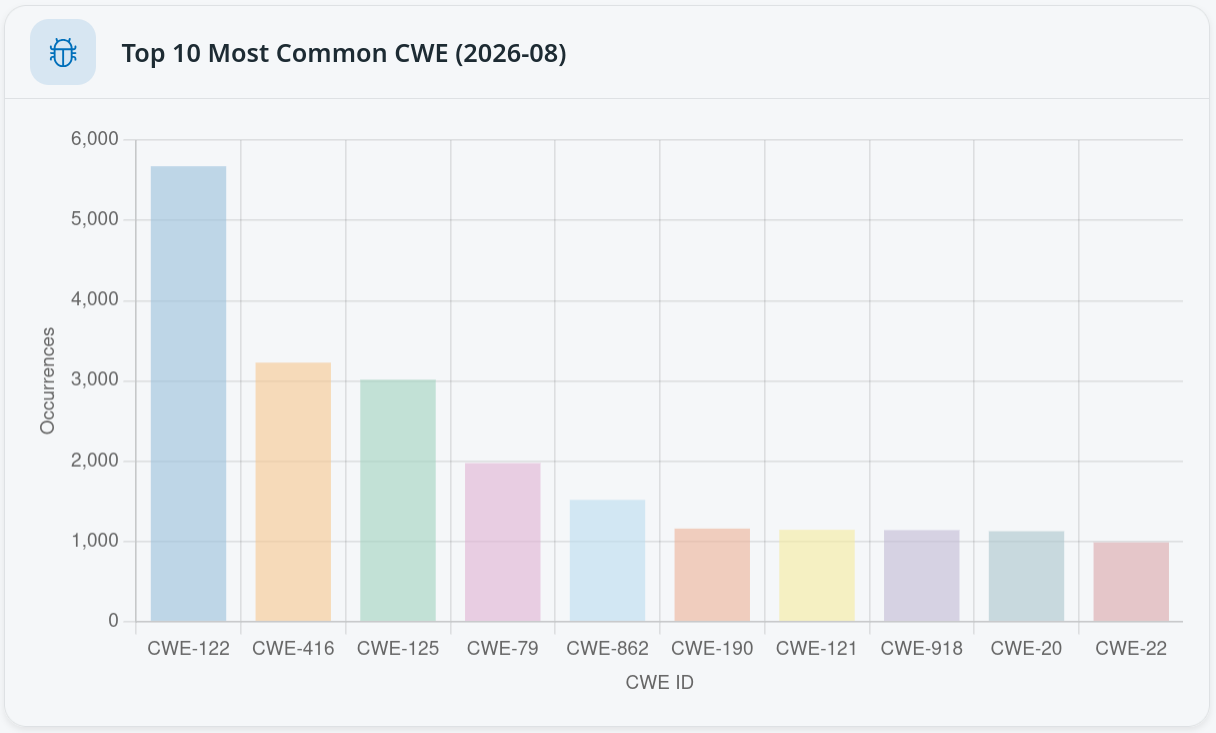
Memory safety keeps the top three places for the second month running, this time led by heap-based buffer overflow (CWE-122, roughly 5,600 occurrences) ahead of use-after-free (CWE-416) and out-of-bounds read (CWE-125); cross-site scripting (CWE-79) stays in fourth place, and missing authorization (CWE-862) enters the top five.
Insights from Contributors
One community comment this month documents exploitation of a vulnerability that no tracked catalog lists yet:
- IFIN Discussion with confirmation of exploitation in the wild – a contributor relays an IFIN network thread confirming in-the-wild exploitation of CVE-2026-59309, the critical authentication bypass in Broadcom VMware vCenter. It is the sibling of the path traversal CVE-2026-59310 that ENISA reported on 10 August and CISA listed on 18 August, and the comment is tagged
vulnerability:exploitability=documented.
Contributors also curated advisories and research into five bundles during August:
- natjack – A New Attack Class Against Network Infrastructure Devices (12 CVEs) – the month’s largest bundle, grouping the NatJack research: a NAT-table manipulation attack class that hijacks TCP connections, tampers with DNS answers or causes denial of service across a wide range of virtual and physical NAT devices, tracked under ten 2023 CVEs and two new 2026 ones.
- Cisco Crosswork Security Hardening Release: August 2026 (4 CVEs) – Cisco’s internal security review of Crosswork, notable for its disclosure model: one CVE per weakness class (CWE) rather than one per bug.
- Debian – DSA 6423-1 kitty security update (4 CVEs) – four issues in the kitty terminal emulator allowing code execution, shell command injection or file overwrite when untrusted content is displayed.
- ZOOMSDAY – How A Security Found a Nation-State Vulnerability in Zoom in One Day (3 CVEs) – a zero-click remote code execution against every native Zoom client, reachable by any meeting participant, discovered with publicly available frontier AI models; a data point on AI-assisted offensive research.
- NetScaler ADC and NetScaler Gateway Security Bulletin for CVE-2026-19489 and CVE-2026-19490 (2 CVEs) – Citrix’s critical August bulletin for NetScaler 13.1 and 14.1, a companion to the KEV-listed memory overflow CVE-2026-8452.
Thank you
Thank you to all the contributors and our diverse sources!
If you want to contribute to the next report, you can create your account.
Feedback and Support
If you have suggestions, please feel free to open a ticket on our GitHub repository. Your feedback is invaluable to us!
https://github.com/vulnerability-lookup/vulnerability-lookup/issues/
Funding

The main objective of Federated European Team for Threat Analysis (FETTA) is improvement of Cyber Threat Intelligence (CTI) products available to the public and private sector in Poland, Luxembourg, and the European Union as a whole.
Developing actionable CTI products (reports, indicators, etc) is a complex task and requires an in-depth understanding of the threat landscape and the ability to analyse and interpret large amounts of data. Many SOCs and CSIRTs build their capabilities in this area independently, leading to a fragmented approach and duplication of work.
The Computer Incident Response Center Luxembourg (CIRCL) is a government-driven initiative designed to provide a systematic response facility to computer security threats and incidents. The organization brings to the table its extensive experience in cybersecurity incident management, threat intelligence, and proactive response strategies. With a strong background in developing innovative open source cybersecurity tools and solutions, CIRCL’s contribution to the FETTA project is instrumental in achieving enhanced collaboration and intelligence sharing across Europe.
AIPITCH (AI-Powered Innovative Toolkit for Cybersecurity Hubs) is a co-funded EU project supported by the European Cybersecurity Competence Centre (ECCC) under the DIGITAL-ECCC-2024-DEPLOY-CYBER-06-ENABLINGTECH program and CIRCL.
The VLAI severity levels used throughout this report are produced by models developed as part of AIPITCH.