Vulnerability-Lookup 7.0.0 released
We are pleased to announce the release of Vulnerability-Lookup 7.0.0!
This major release is about coordinated vulnerability disclosure. Vulniverse becomes the vulnerability editor, with panels to reserve a GCVE identifier, publish to the CNA, check a record’s quality, start from a template, pick CPEs, and draft a record from a patch with Patch2Vuln. The disclosure workflow gains private notes for the coordination team, a reference to the case in another tool, and insights on how cases move through the process. Only cases set to Disclosed are public now, and a reporter edits a report only until its review starts. Also in this release: a validation endpoint for GCVE records, EUVD numbers received from ENISA, a “Solutions & workarounds” tab on CVE records, and responses and searches kept within a memory budget. It also fixes two security issues in session handling: see below.
Upgrade notes
- Three PostgreSQL migrations:
poetry run flask --app website.app db upgrade(whichpoetry run updateruns). - The vulnerability editor is now off by default. To keep it, add
"vulnerability_editor": TruetoWEB_MODULESinconfig/website.py.VULNERABILITY_EDITORchooses"vulniverse"(the default) or"vulnogram", the editor used until now. The editor moved to/vuln/createand/vuln/<id>/edit; the former URLs redirect there. config/vulniverse.jsonandconfig/patch2vuln.jsonare optional: without them the website reads the samples, and Patch2Vuln stays off.- Every user is logged out once after the upgrade: sessions are now bound to the user’s password.
- Gunicorn takes four new settings from
config/generic.json.sample: 100 simultaneous clients per worker instead of 1000, workers recycled after about a thousand requests, and 30 seconds to drain on stop and restart. Raisewebsite_worker_connectionsfor many SSE subscribers. - The “Disclosure” menu is now “Advisories”, and the account menu is named after your login.
- EUVD: numbers are no longer issued by Vulnerability-Lookup, only by ENISA’s instance. An instance that enabled the former
[feeder:euvd]section removes it and runstools/purge_euvd_allocations.py. An instance holding EUVD records runspoetry run index_vulnerabilities --source euvd. The changelog has the details. - Delete
website/web/static/js/vendor/, which is no longer used.
Security
This release fixes two weaknesses in session handling, reported by Michael Reimsbach. We recommend upgrading.
- A feed key or an API key opened a web session (GCVE-1-2026-20245). A request authenticated with a feed key (in the URL) or an API key (
X-API-KEY) received a session cookie valid on every page, without password or two-factor authentication. A leaked feed URL gave access to the account page, including the user’s API key, and to the administration for an administrator. These keys now authenticate the request only. - A password change did not end the user’s other sessions (GCVE-1-2026-20340, CWE-613). A session opened by someone else stayed open after the user changed their password, after an account recovery, or after an administrator set a new one. Sessions are now bound to the password; the user who changes it stays logged in. This is why every user is logged out once after the upgrade.
In addition, a write to the API made from a browser session now checks the CSRF token, as the rest of the website does. API clients using X-API-KEY are not affected.
What’s New
Vulniverse, the ultimate vulnerability editor
We are happy to have replaced Vulnogram with a more modern, friendly and extensible editor. Vulnogram served us well, and remains available for the instances that prefer it (VULNERABILITY_EDITOR = "vulnogram"), but Vulniverse is now the default.
Vulniverse is a modular editor for vulnerability records, developed in its own repository and embedded in Vulnerability-Lookup. Its panels are chosen in config/vulniverse.json:
- GCVE reservation and CNA publication, without leaving the editor;
- Record quality, a score out of 100 for the record being written, by the rules of the assigner scorecard: can a reader tell what the vulnerability is, whether they are affected, how bad it is, and what to do about it;
- Templates, kept per instance, to start a record from a known shape;
- CPE suggestions for vendors, products and CPEs, from the instance’s CPE data;
- Patch2Vuln, which drafts a record from a software patch with an external Patch2Vuln service using large language models. The draft is a starting point: the documentation’s AI-Assisted Vulnerability Records explains the steps from a patch to a published record.
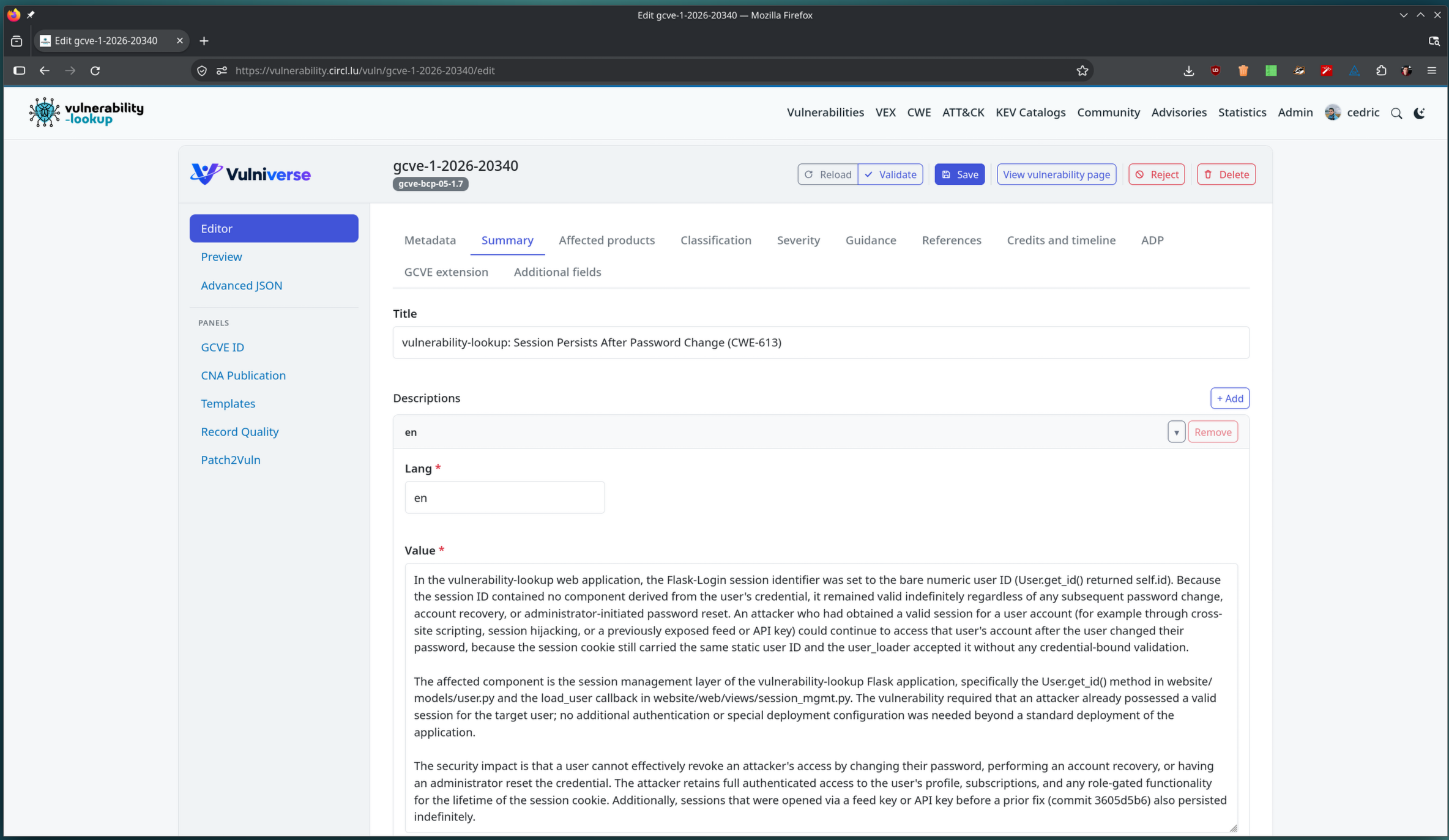
Vulniverse editing GCVE-1-2026-20340, one of the two security fixes of this release: the record in tabs, its panels on the left.
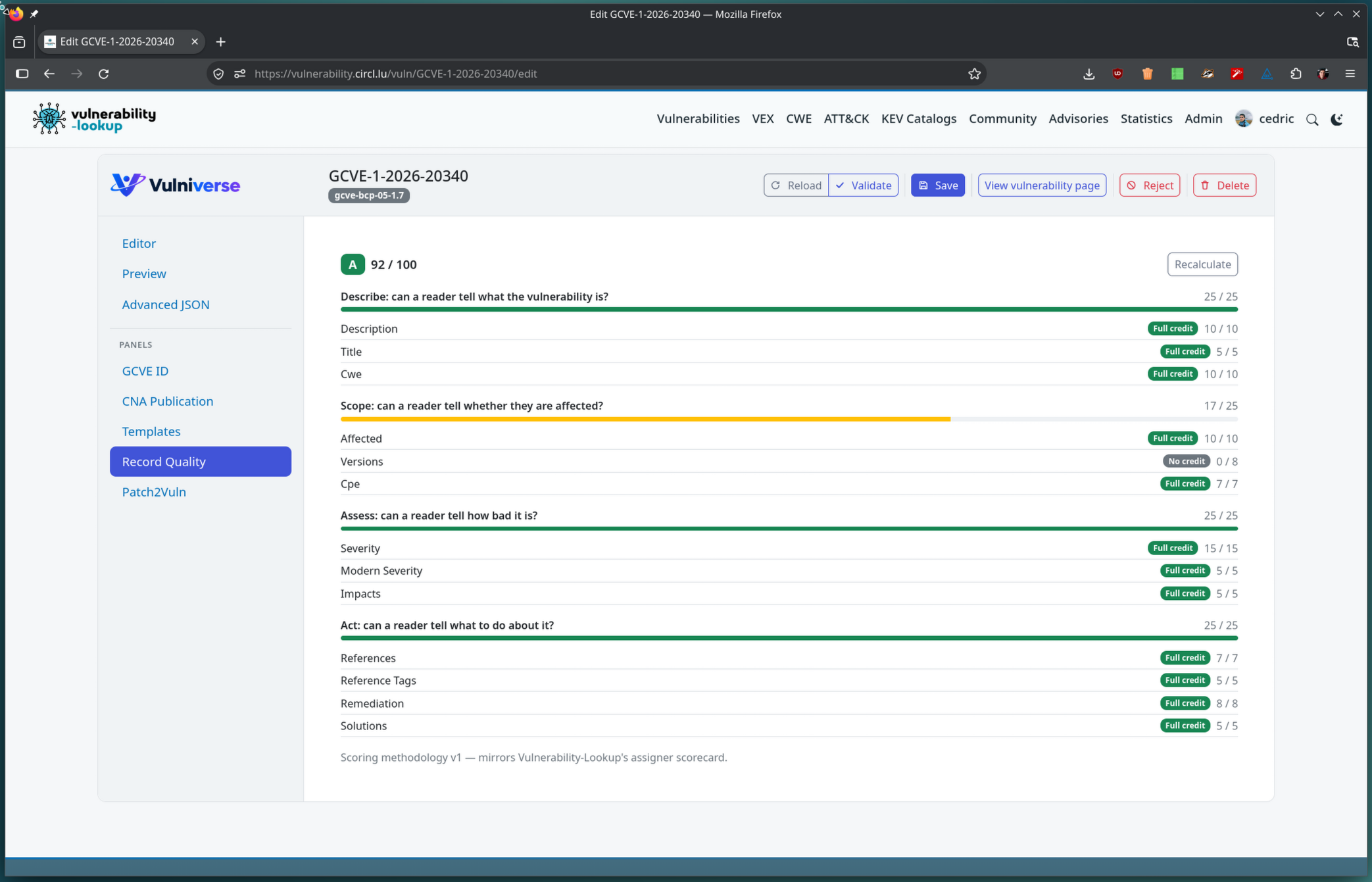
Record quality, while you write: 92/100 for GCVE-1-2026-20340, with the versions as the one thing left to add. The scoring mirrors the assigner scorecard of Vulnerability-Lookup.
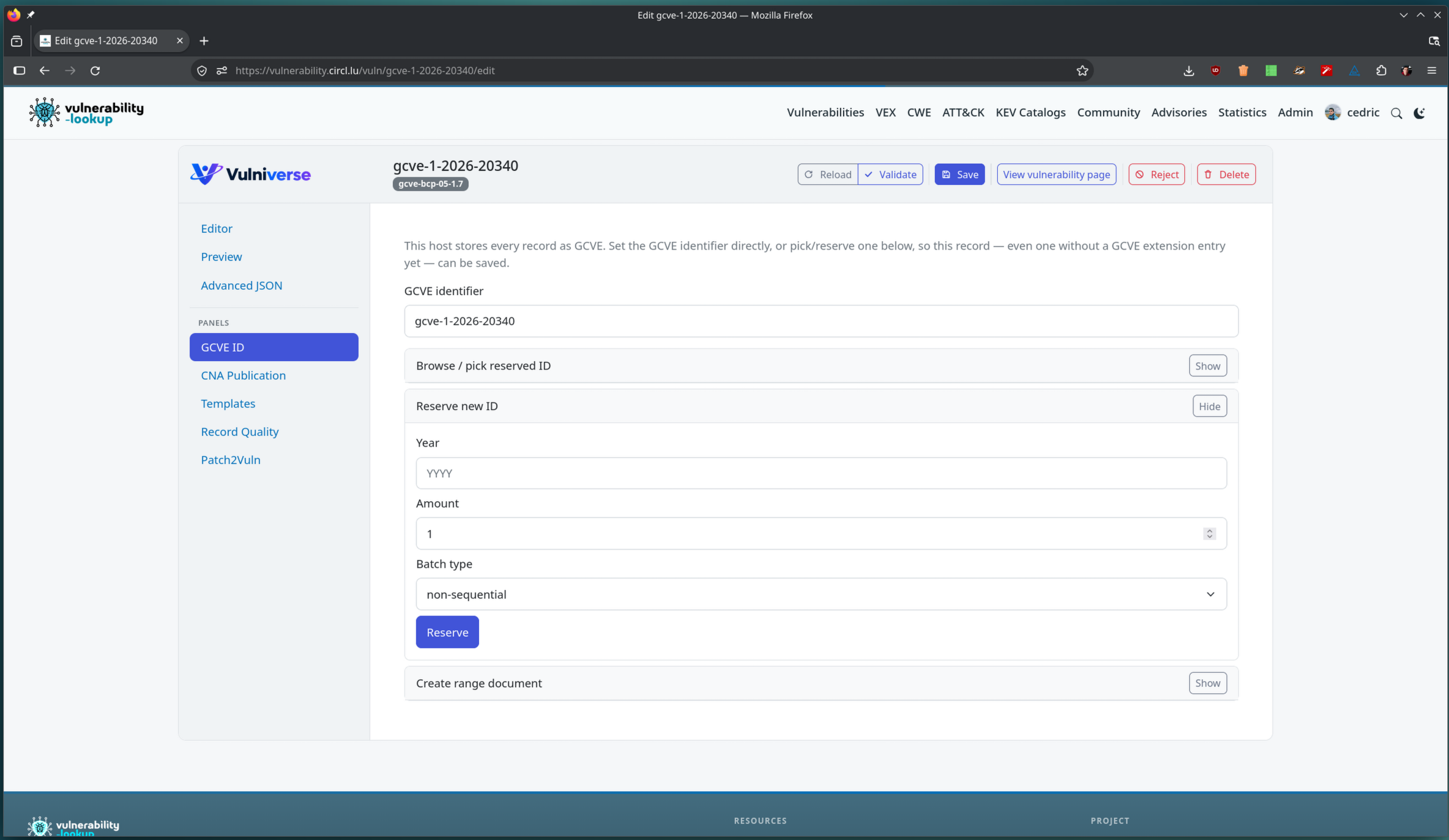
The GCVE ID panel: set the identifier, pick one already reserved, or reserve new ones without leaving the editor.
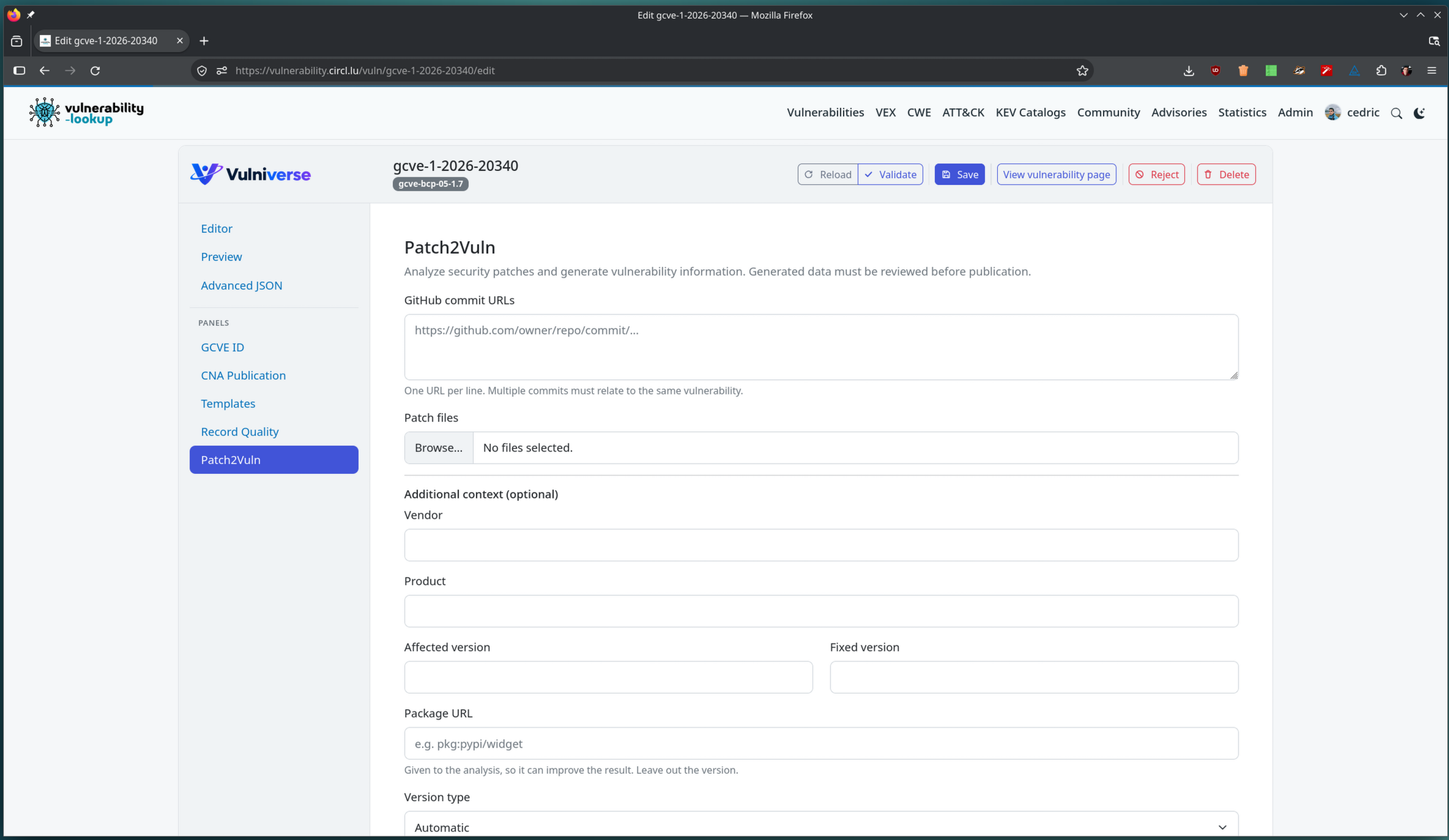
The Patch2Vuln panel: give it commits or patch files, and some context, to draft the record. Generated data must be reviewed before publication.
The CNA publications list and pages link to the editor of each record. The editor is an optional module: every page and API works with it off, and the CNA API still creates and updates records.
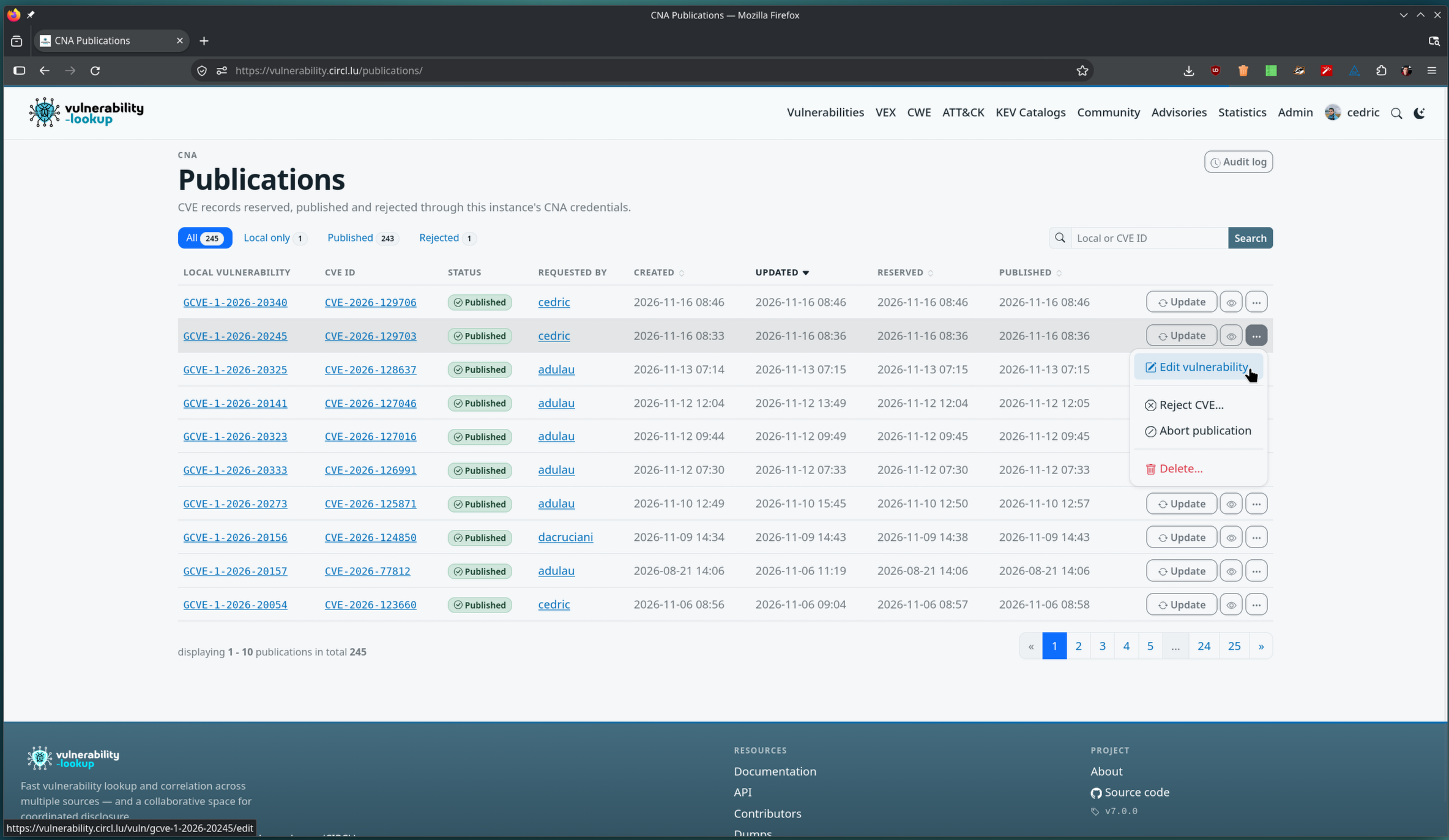
From the CNA publications, "Edit vulnerability" opens the record in the editor.
The Vulniverse integration was contributed by NMD03.
Coordinated vulnerability disclosure
- Private notes. A Notes tab keeps short, dated notes on a case (a vendor ticket number, a phone call, the next step), seen only by the people who manage disclosures. They send no e-mail and are not part of the discussion.
- External reference. Many CSIRTs handle the exchanges with the vendor in another tool (RTIR, Flowintel, a web form, e-mail). A disclosure keeps a reference or a link to that case. The queue’s search matches it, and the reporter never sees it.
- Insights. The admin queue ends with figures on the process: open cases, cases waiting for a reply or past their disclosure date, median times to the first response, to the vendor contact, to approval and to publication, the cases due to go public in the next 90 days, how cases ended, and the reports per month.
- The dashboard links the disclosures to triage and those awaiting a reply, and a GNA instance’s dashboard links its publications.
- Publication follows the team’s decision. An approved case no longer becomes public when its disclosure date passes. It is public once the coordination team sets it to Disclosed.
- Reports stay stable during the review. The reporter edits a report only while it is Reported or Waiting for reporter. Each edit is noted in the discussion and e-mailed to the team. The description and confidential details can be copied as Markdown.
vulnerability_disclosure:reviewis enough to manage disclosures: it includes reading and discussing them.
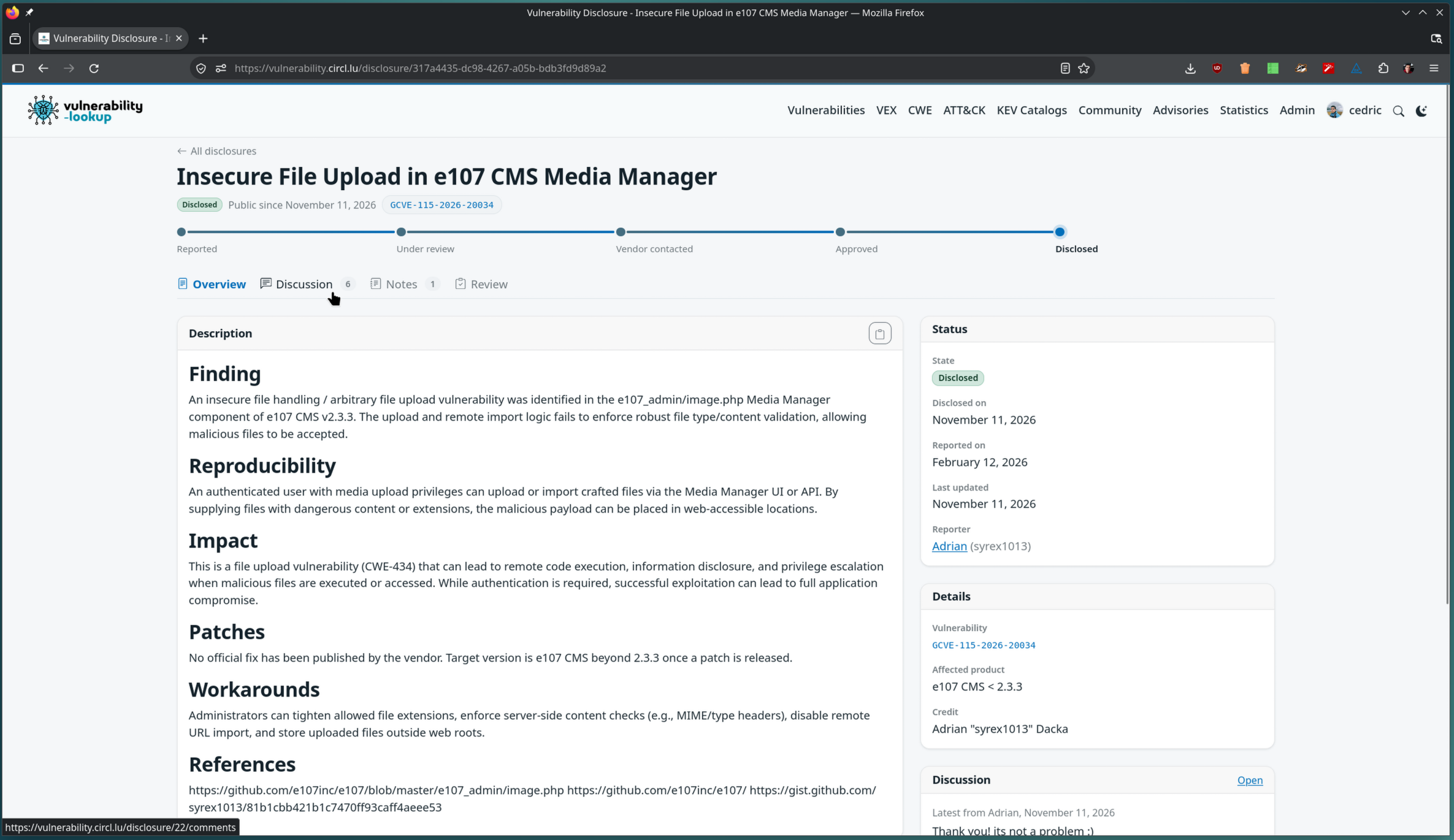
A disclosed case, seen by the coordination team: its progress, the Notes tab next to the discussion, and a button to copy the reporter’s description.
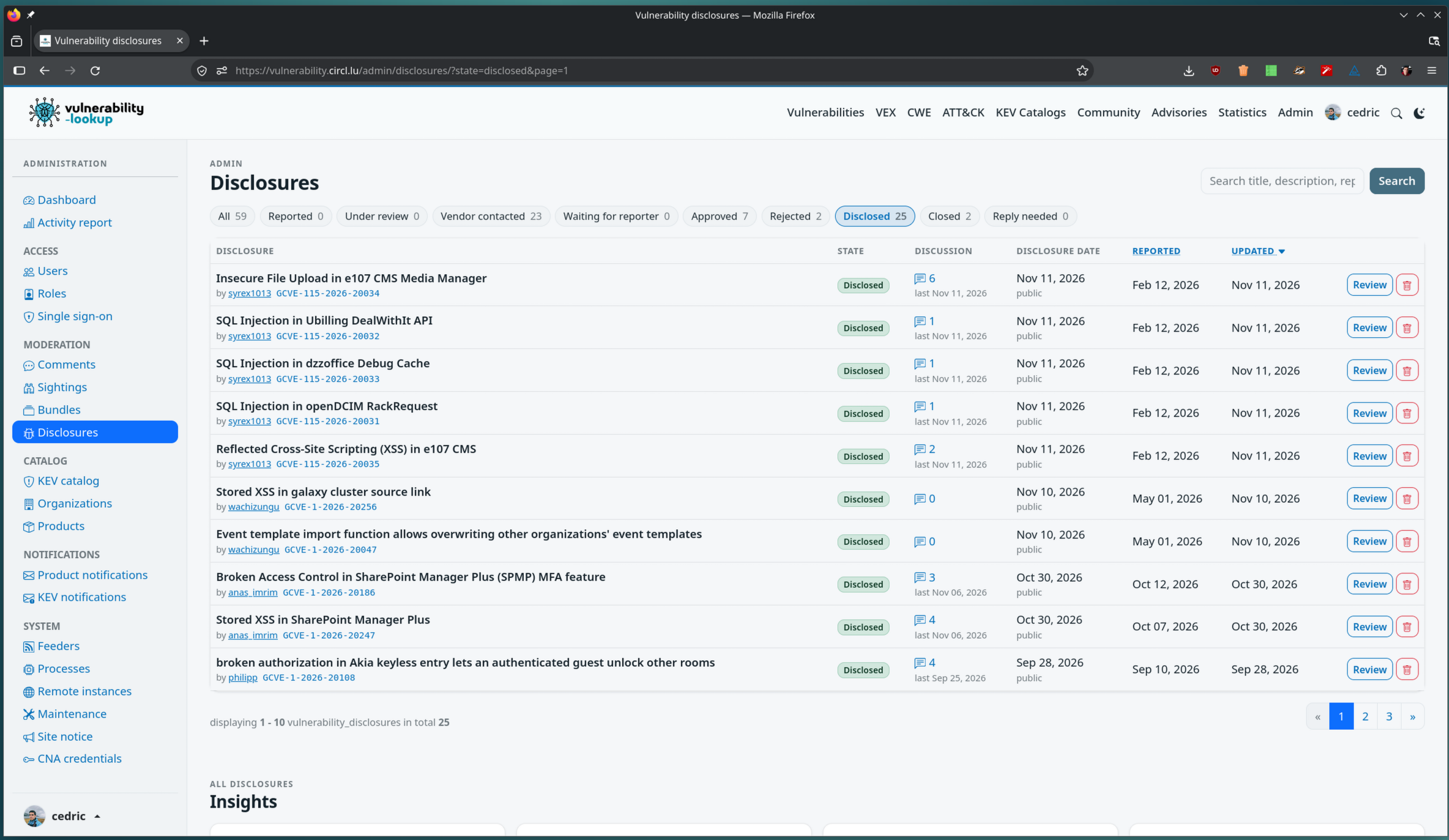
The disclosure queue, by state, with the cases that need a reply. The insights follow below the list.
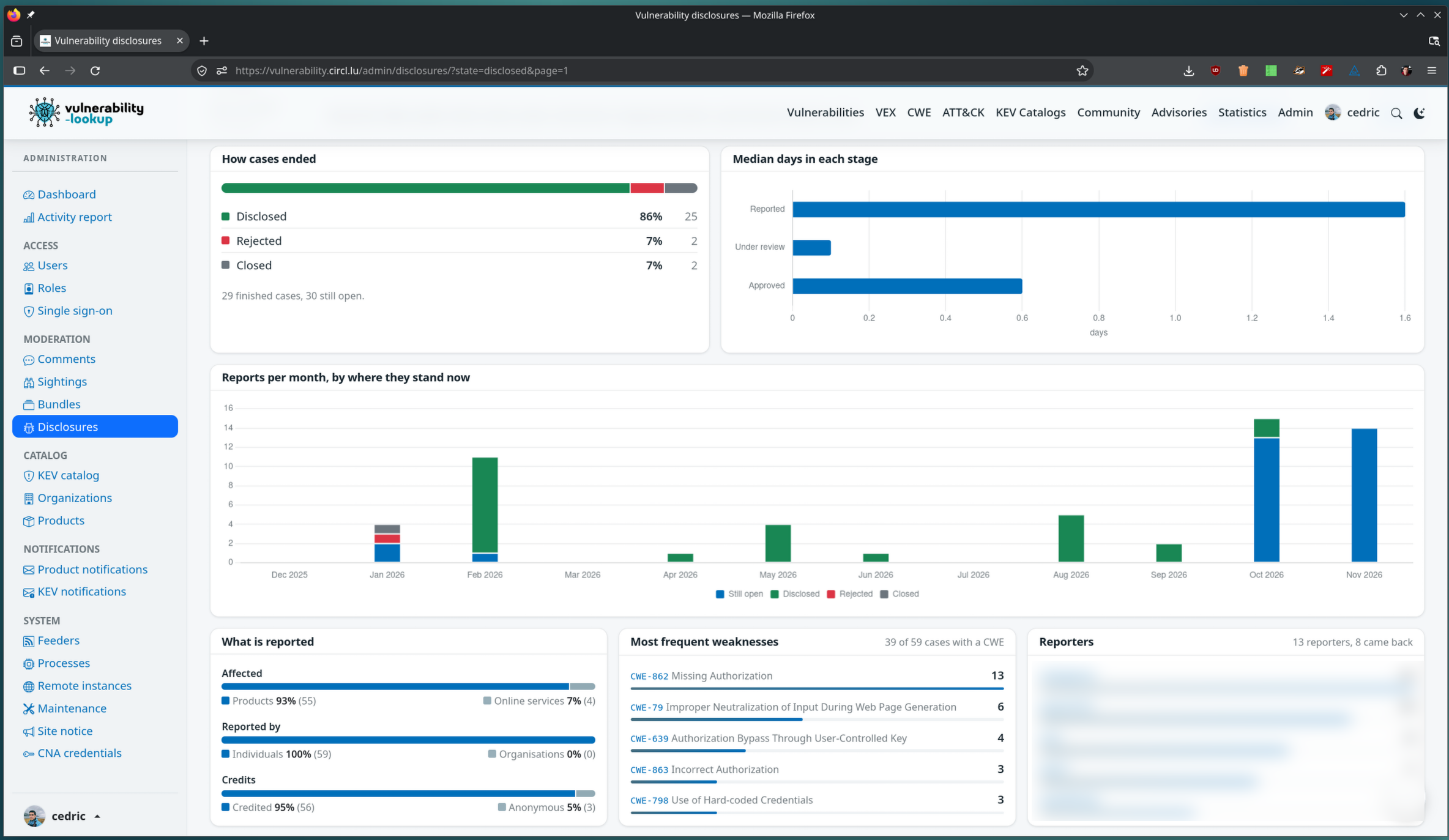
Insights on the process: how cases ended, the time spent in each stage, the reports per month, and what is reported. The reporters are blurred: the figures include cases that are still open.
A new Coordinated Vulnerability Disclosure section of the documentation covers the whole process: enabling the module, who does what, the lifecycle, the reporter’s and the coordination team’s sides, publishing the record, and the e-mails sent.
Validating GCVE records
POST /api/vulnerability/validate checks a record without storing it: the CVE Record Format, the GCVE identifier, every x_gcve entry against GCVE-BCP-05, and each registered extension against its schema. Errors and warnings come with their JSON path. The editor uses it. Contributed by NMD03.
EUVD numbers from ENISA
EUVD numbers are now issued only by ENISA’s instance. The new enisa_euvd feeder, off by default, receives them: it loads ENISA’s export once, then follows /api/euvd/changes. Received EUVD records are listed on the Recent page and in the feed. Contributed by Nikiforos Archakis.
A refreshed dashboard
The homepage’s trending table is now a heatmap: totals, a “new” badge for vulnerabilities first sighted in the last three days, threshold buttons, a colour scale for the whole table or per line, and filters kept in the URL, so a view can be shared. The Charts tab explains each sighting type.
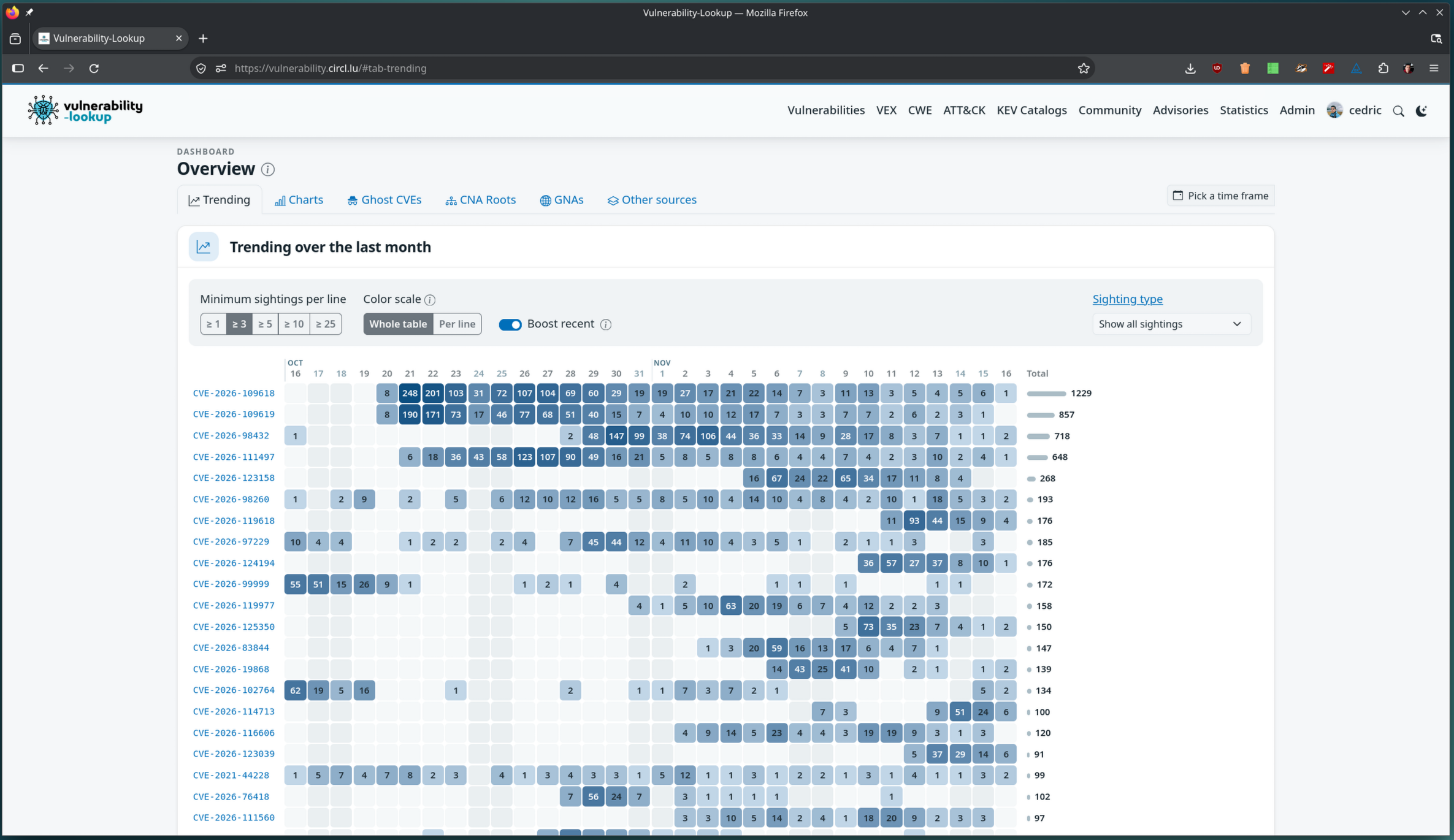
Trending over the last month: one line per vulnerability, one cell per day.
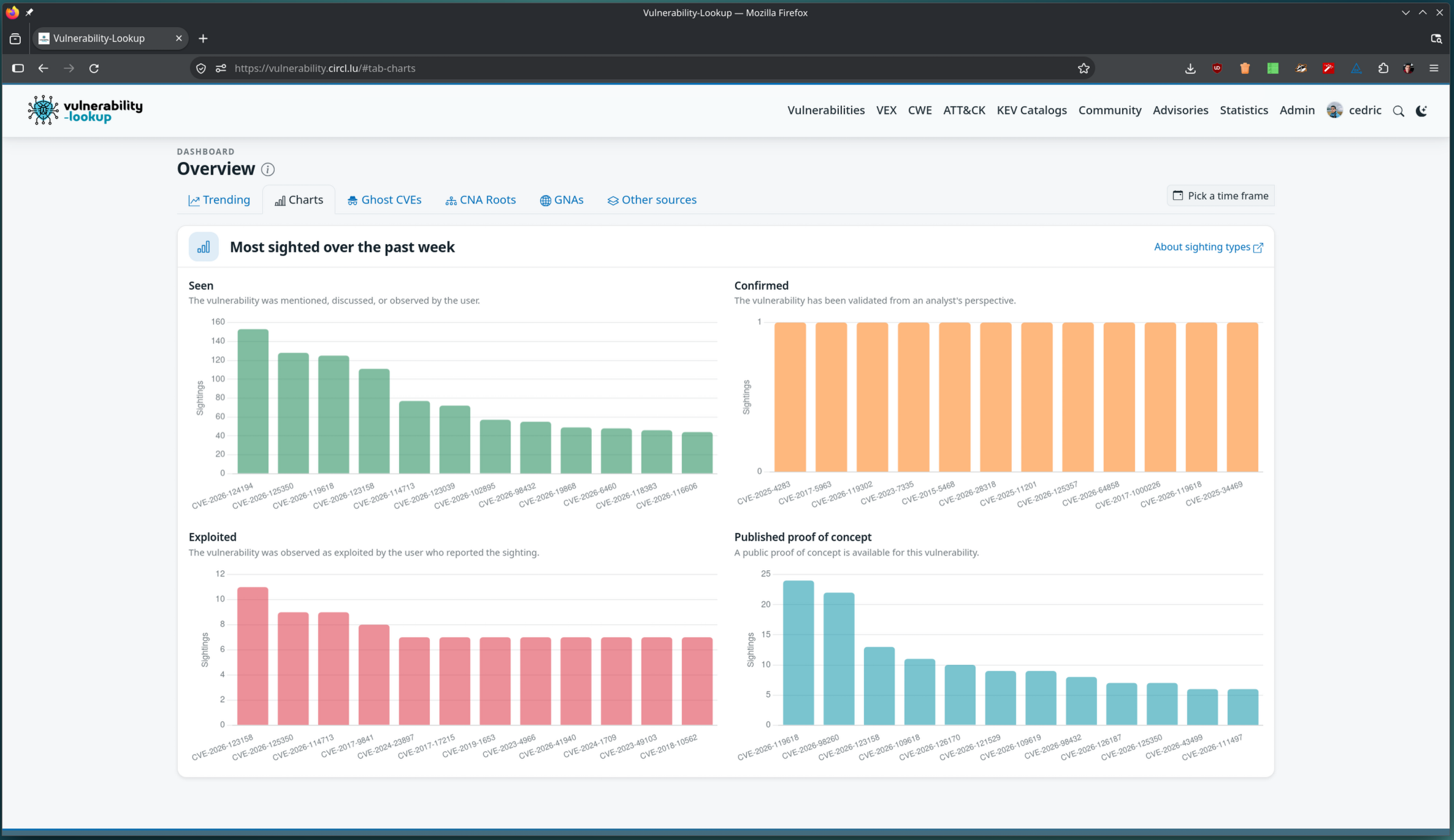
The most sighted vulnerabilities of the week, by sighting type.
And more
- Solutions & workarounds — A CVE record’s page shows the workarounds, configurations, solutions and exploits given by the CNA and the ADPs, in a tab of their own.
- AI coding agents — Two skills, to add a vulnerability source and to prepare a release, and an up-to-date
new_source.md. - VLAI — Our severity classification model, CIRCL/vulnerability-severity-classification-roberta-base, passed 35,000 downloads on Hugging Face, 12,300 of them in the last 30 days.
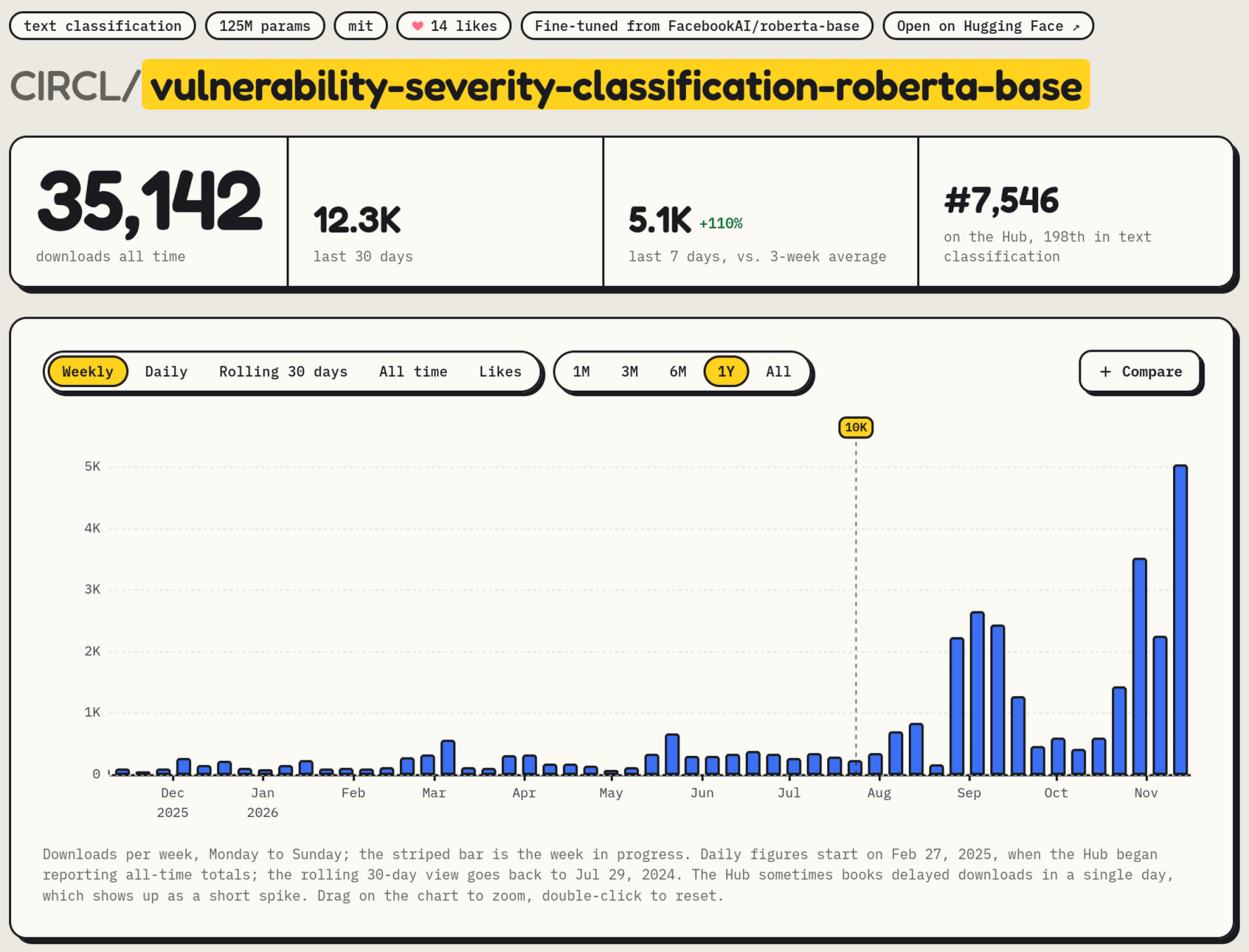
Weekly downloads of the VLAI severity model over the last year.
Changes
- Memory — Bulk lookups, linked records, the timeline and searches read within a budget of 16 MiB of stored JSON. Records linked to Linux kernel or Go CVEs reach hundreds of megabytes, and the website’s workers grew to 12 GB on production. A CVE card lists its first 50 affected products outside the record’s own page. Search work contributed by Alexandre Dulaunoy.
- CNA API — The instance’s CNA is recorded as the owner of its IDs, and
PUT /api/cna/cve-id/<id>keeps the state indexes in step. The index fix was contributed by Johnny Kao. - CSAF — CERT-Bund advisories published hours after the date they carry are no longer missed, and the publication lag is a per-feeder setting. Contributed by Nikiforos Archakis.
- Stream — Sightings, bundles and comments created through the API are streamed again.
- Website — An account menu with the user’s avatar, and an About page GNA check that compares the host the visitor reached.
- Dependencies — Updated Python and frontend dependencies, Bootstrap 5.3.9 among them. highlight.js is served from its browser-ready package, without a bundling step.
Changelog
📂 For the full list of changes, including the fixes, check the GitHub release:
https://github.com/vulnerability-lookup/vulnerability-lookup/releases/tag/v7.0.0
🙏 A big thank you to all contributors and testers!
Feedback and Support
If you encounter any issues or have suggestions, feel free to open a ticket on our GitHub repository:
https://github.com/vulnerability-lookup/vulnerability-lookup/issues/
Your feedback is always appreciated!
Follow Us on Fediverse/Mastodon
You can follow us on Mastodon and get real-time information about security advisories:
https://social.circl.lu/@vulnerability_lookup/