Vulnerability-Lookup 7.1.0 released
We are pleased to announce the release of Vulnerability-Lookup 7.1.0!
This release brings twelve new sources: Debian ELTS, the Debian Security Tracker and Alpine Linux, and the OSV databases of Android, Azure Linux, Docker Hardened Images, Julia, the Python Software Foundation, V8, R, Root.io and Go. OSV cards now show the impacted products, the list of disclosed vulnerabilities shows public insights on the disclosure process, and the Vulniverse editor gains a tree view of the record, a download action and a tutorial. It also fixes a security issue in two-factor authentication: see below.
Upgrade notes
- One PostgreSQL migration:
poetry run flask --app website.app db upgrade(whichpoetry run updateruns). It cuts the sightings already stored to 65,536 characters; on an instance with very long sightings, aVACUUM sightingafterwards lets PostgreSQL reuse the space. - The new sources are off by default. To use one, copy its section from
config/modules.cfg.samplewithenabled = true, and its entry fromconfig/website.py.sampletoSOURCESinconfig/website.py. The search offers it once it is inSOURCES_TO_SHOW. Debian ELTS, Azure Linux, Docker Hardened Images, Julia, the Python Software Foundation, V8 and R are git submodules: fetch the one you enable withgit submodule update --init <path>, its path is in.gitmodules. - Some OSV sources were renamed in
config/website.py.sample, with the publishers’ own spelling: OSV OCaml, OSV OSS-Fuzz, OSV RustSec, OSV Bitnami VulnDB, OSV CleanStart, OSV Drupal. Copy the names toconfig/website.pyif you want them.
Security
- Disabling two-factor authentication now asks for your password (GCVE-1-2026-20335, CWE-352). On an instance that does not enforce 2FA, the profile page turned it off with a plain link. A request sent from another page, such as an image in a comment, could trigger it too, and remove the second factor of whoever viewed that page. It is now a form, and your password is required to turn 2FA off. Instances with
ENFORCE_2FA = True, the default, were not affected. Reported by @orshih6. We recommend upgrading.
What’s New
Twelve new sources
- Debian ELTS, Freexian’s extended LTS advisories in OSV format, and the Debian Security Tracker, with the package and release status of each CVE.
- Alpine Linux, from secdb. A package never affected by a CVE shows as “Not affected”.
- OSV Android, Android Security Bulletins included.
- OSV Azure Linux, OSV Docker Hardened Images, OSV Julia, OSV Python Software Foundation (CPython and the other PSF projects) and OSV R (CRAN and Bioconductor).
- OSV V8, the Chromium Policy Vulnfeed advisories for outdated V8 revisions.
- OSV Root.io and OSV Go, from the APIs of their publishers.
Each one is searchable and has its card. A record whose identifier does not belong to its source, such as a V8 or R file declaring a CVE identifier, is skipped, so that it cannot overwrite another source’s record. The new sources were contributed by Alexandre Dulaunoy.
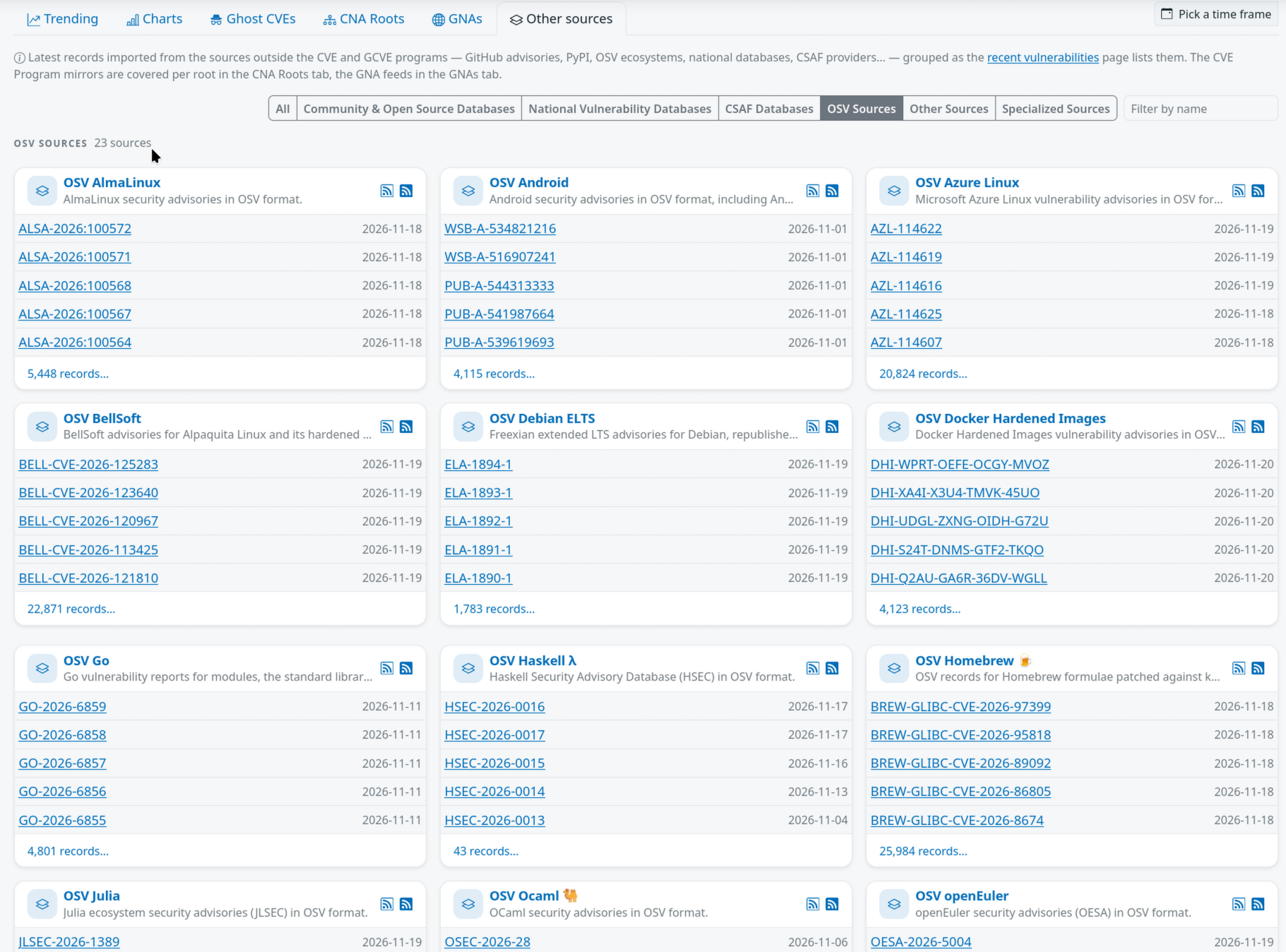
The OSV sources on the dashboard, among them OSV Android, Azure Linux, Debian ELTS, Docker Hardened Images, Go and Julia, new in this release.
Impacted products on OSV cards
OSV cards show the packages and versions an advisory is about: ecosystem, package and purl, with the affected ranges and versions, in a collapsible box with a filter, as on CVE cards. Ecosystem and package link to the vendor and product search. All aliases, upstream and related identifiers are linked, not only the first one.
Public insights on disclosures
The list of disclosed vulnerabilities now ends with figures on the process, without logging in: the reports per month and how cases ended, and, for the disclosed cases only, what is reported, the most frequent weaknesses and the times. The operational figures, such as the cases waiting for a reply and the reporters, stay in the coordination team’s queue.
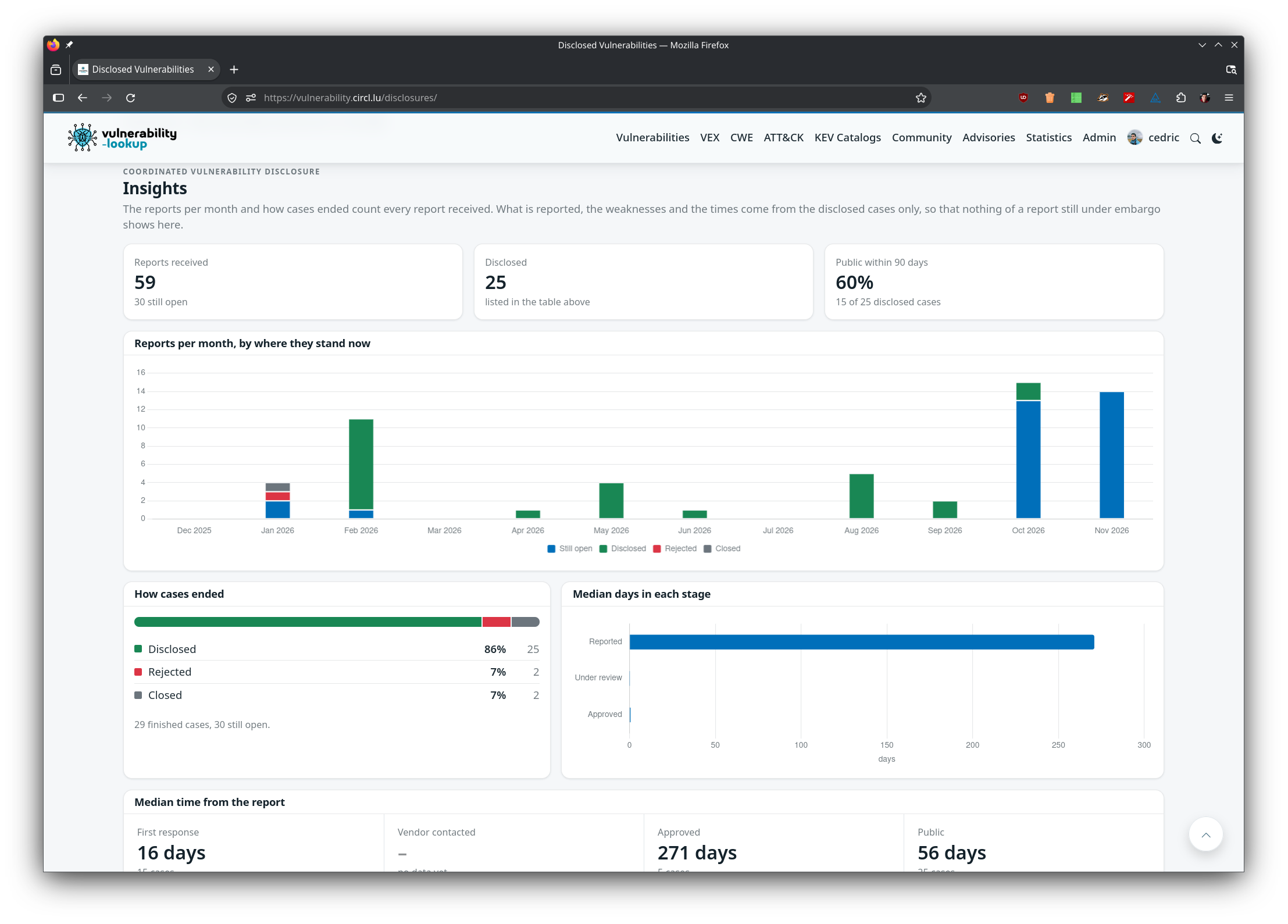
The public insights on the disclosure process, under the list of disclosed vulnerabilities.
Vulniverse
A new build of the editor, contributed by NMD03:
- Tree — the whole record as a tree, to see what is missing.
- Download — the record as JSON, HTML or PDF.
- Tutorial — a short tour of the editor.
The last two screenshots show two helpers the editor already had, worth knowing about: the CVSS calculation and the vendor and product suggestions.
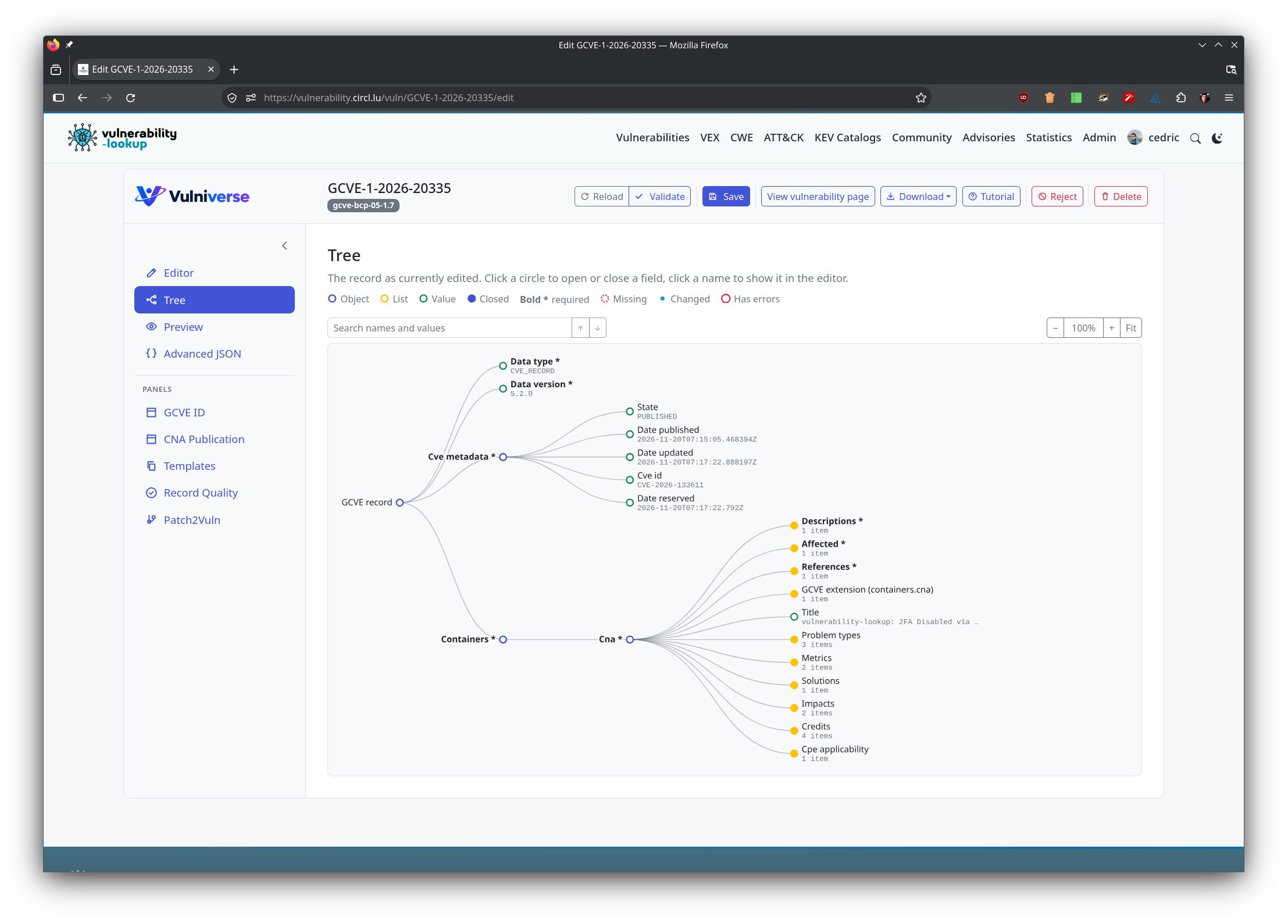
The Tree view: the whole record at a glance, here GCVE-1-2026-20335, the security fix of this release.
The tree makes it easy to see what is still missing: required fields left empty, and fields with errors, are marked. A click on a field’s name jumps to its section in the editor, ready to be completed.
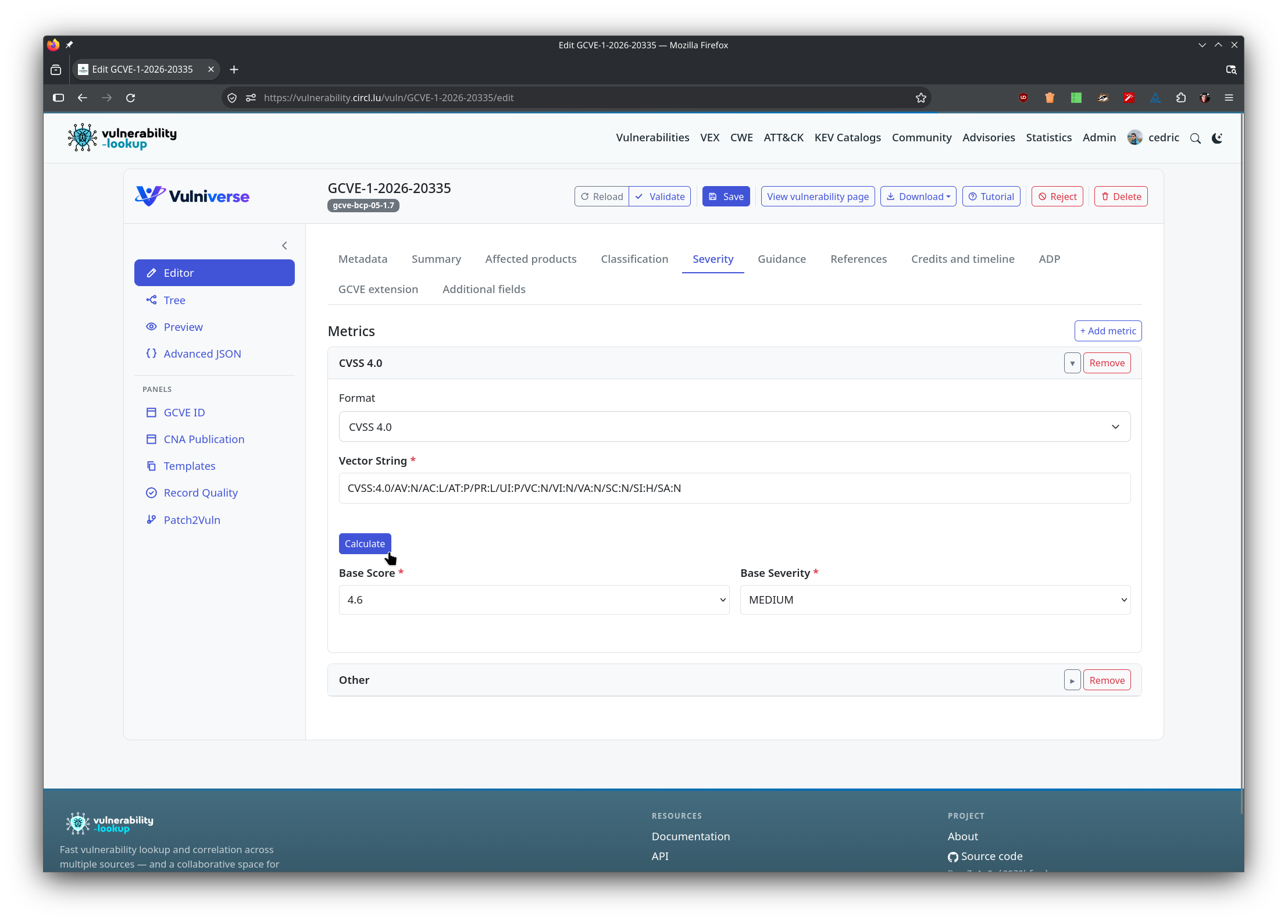
Calculate fills the base score and severity from the CVSS vector.
A CVSS vector can be copied from another tool, such as a CVSS calculator or another record, and pasted into the vector string field. Calculate then fills the base score and the severity, so they always match the vector.
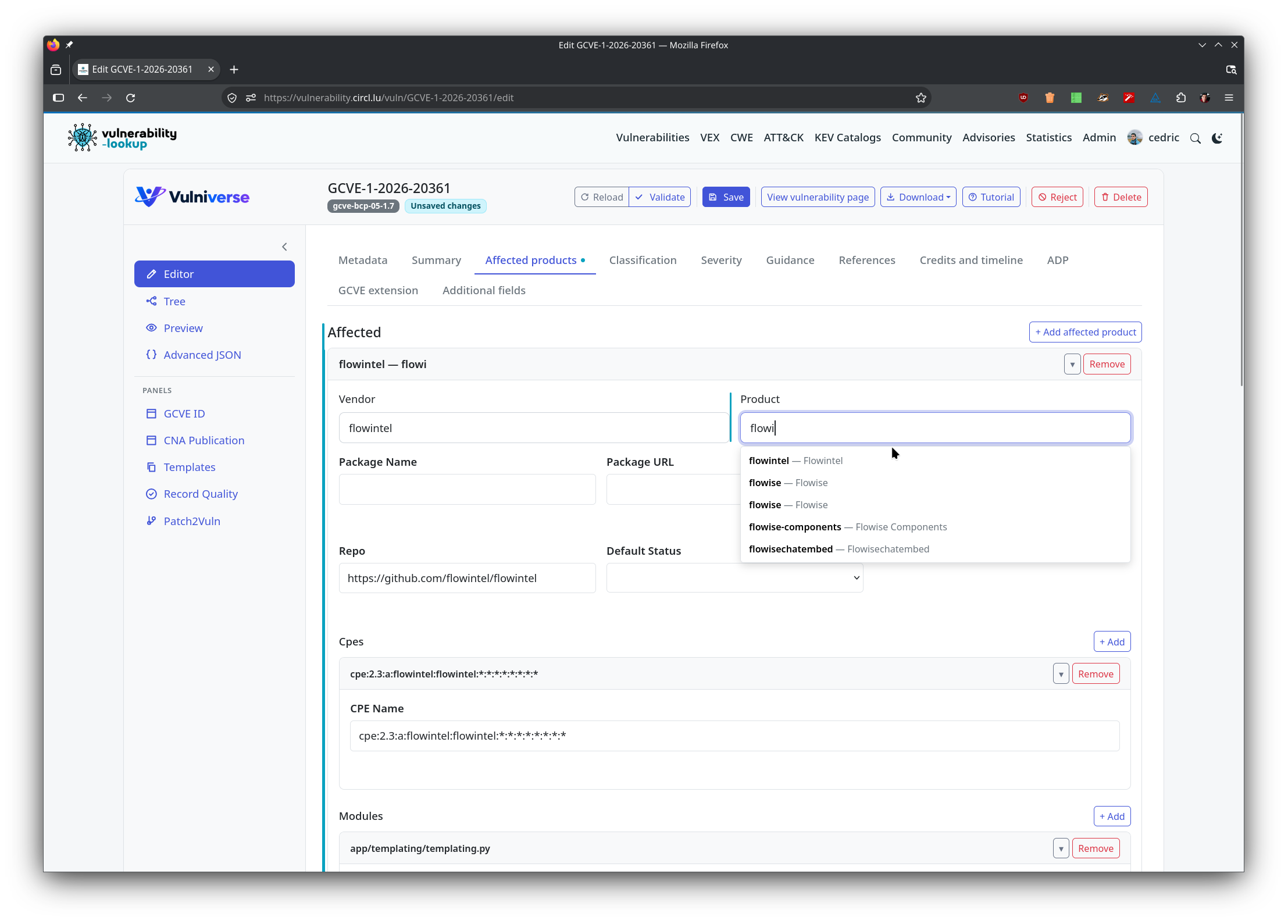
Vendor and product names are suggested as you type.
The suggestions come from cpe.gcve.eu, the GCVE CPE Editor, or from another instance of it. They are off by default: set cpe_enabled and cpe_url in config/cpe.json, and enable cpeVendors and cpeProducts in config/vulniverse.json.
Changes
- Statistics — The charts follow the theme, dark theme included, and the vendor and assigner rankings are horizontal bars instead of pies.
- GCVE records — A record whose single
x_gcveentry is not an advisory is accepted, as GCVE-BCP-05 allows, andproviderMetadata.orgIdis optional, as in GCVE-BCP-03. - Sightings — A sighting keeps at most 65,536 characters of content. Some held whole log files, which stopped the synchronisation of sightings between instances.
- Website — Source pickers show every match, not the first four, and forms are no longer drawn inside a grey box.
- Dependencies — Updated Python dependencies.
Changelog
📂 For the full list of changes, including the fixes, check the GitHub release:
https://github.com/vulnerability-lookup/vulnerability-lookup/releases/tag/v7.1.0
🙏 A big thank you to all contributors and testers!
Feedback and Support
If you encounter any issues or have suggestions, feel free to open a ticket on our GitHub repository:
https://github.com/vulnerability-lookup/vulnerability-lookup/issues/
Your feedback is always appreciated!
Follow Us on Fediverse/Mastodon
You can follow us on Mastodon and get real-time information about security advisories:
https://social.circl.lu/@vulnerability_lookup/